

2026 Mid-Year Update
In this mid-year update, we cover where markets stand heading into the second half of 2026, the adjustments our investment committee made last quarter, and two planning topics you'll want to know about: the new Trump Accounts for kids and the return of the ACA subsidy cliff.
MFG Happenings
By Michael Macco, CFP®, CIMA®

The Macco Financial Group team.
The first half of 2026 has continued the momentum and evolution we experienced throughout last year. This spring, Ali Janquart graduated and officially joined Macco Financial Group full time. Many of you have already had an opportunity to meet or work with her over the past year. Ali passed the CERTIFIED FINANCIAL PLANNER® competency exam on July 21st. The CFP® exam requires a significant commitment of time and preparation, and we are proud of the work she has put in to reach this point. We have strong confidence in her and look forward to seeing what comes next.
We also welcomed Garrett Staszak as our summer intern. Garrett passed the Securities Industry Essentials® exam on July 15th. He will return to UW–Stevens Point this fall to finish his degree in December. Garrett has been a great addition to the office, and we enjoyed getting to know him and watching him grow professionally.
There has been exciting news outside the office as well. Andrew and Amanda Froelich welcomed their third child, Grant, on June 22nd. Mom and baby are doing well, and we are thrilled for the Froelich family as they adjust to life with three children.
Over the coming months, many of you may see more of Morgan, Ryan, and Ali in meetings and throughout the planning process. Their growing involvement allows us to bring more of the team's knowledge and perspective into each client relationship, while Patrick, Andrew, and I continue in our roles as lead advisors and primary points of contact.
I truly believe we have an exceptional group of people here at Macco Financial Group. They work hard, care deeply about the people we serve, and continue to pursue the level of excellence our clients deserve.
Patrick's Ponderings
By Patrick Stoa, CFP®
Politics
I just visited with Robert Stein, CFA, the Deputy Chief Economist at First Trust, and he started off the conversation with politics. For better or worse, mid-term elections are upon us soon. Historically, the party that does not have the Presidency gains a few seats in Congress or the Senate. Realistically, the only thing this means is that starting in 2027, any bills that are likely to get to the President's desk will have at least some bipartisan compromise in them.
Two items that are forever confusing to me: no major politicians seem concerned that the National Debt continues to rise at a moderate pace, and Social Security will have funding problems around 2034. These aren't going away, so I am sure they will come up in the future.
Economy
Meanwhile, a few major trends are affecting the US economy in interesting ways. In many parts of the country, house prices are stabilizing or even declining. One factor that may be contributing is that it appears we don't need as many new houses because net immigration is neutral or declining, while the birthrate is also more or less neutral. At the same time, productivity per worker is up modestly. In the past, higher productivity meant unemployment could rise as people were let go. But with lowered net immigration, there just aren't as many workers available anyway. Therefore, unemployment has only risen slightly, and at 4.2% is still well below long-term averages. Inflation is still with us, but at a somewhat reduced rate. The Fed seems inclined to keep rates fairly stable for the foreseeable future.
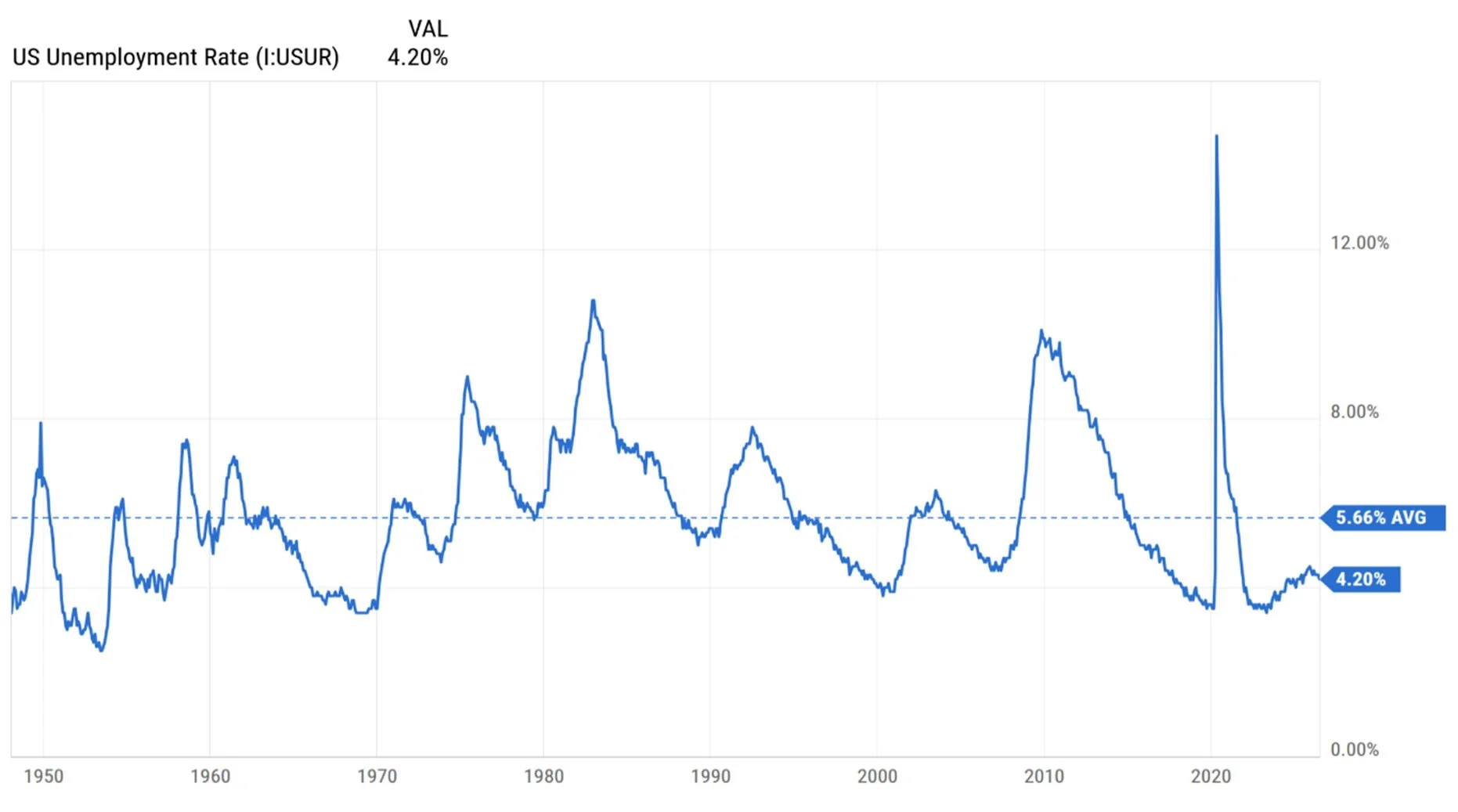
US Unemployment Rate, 1950–present. Source: YCharts.
Market

Capex from the major AI hyperscalers (Alphabet, Amazon, Meta, Microsoft, Oracle), USD billions.
It's an open question as to what will happen with the Strait of Hormuz, but the US produces plenty of its own oil. We still import some because we don't have all the right types, but broadly we are not at any major risk due to the situation in Iran. Oil and gas prices have come down from their peaks and are likely to stay reasonable for the foreseeable future. Some other countries such as India and China were much more reliant on Iranian oil, and they are paying the price for that now.
2026 is definitely a year of continued massive AI investment throughout the economy. Several major corporations are spending a few hundred billion dollars on AI chips, datacenters, power, and connective networks. In just a few years they are expected to spend as much as $1 trillion per year!
This theme will play out in unimaginable ways over the next 10–15 years. To give an idea of how far we might go, consider this: September 25th, 1956 — just 70 years ago — was when the first telephone cable reached between North America and Europe. It could handle a maximum of 35 simultaneous calls between the continents, and the cost was about $35 per minute in today's dollars. This seems almost silly in the age of AI. Yet someone will look back at us, 70 years from now, and ponder at our primitiveness.
In the stock market itself, by many measures, valuations could be considered elevated. Overall P/E ratios of the S&P 500 remain on the high side, around 20. The long-term average is around 15–17, depending on what timeframe you pick. Meanwhile, companies are quite profitable. Robert Stein seems to think that if you adjust accounting methods to the same methods commonly used some years ago, the current market would represent a normal, rather than high, valuation. I am a little more pessimistic. Broadly, we have made some investment tweaks so that if a market downturn happens, we hope to absorb a little less of it, particularly in our more conservative portfolios.
MFG Investment Committee Positioning
By Andrew Froelich, CFP®, CIMA®
While we have more clarity about the future than we did in March, there are still many unanswered questions about where capital markets, the US economy, and executive decisions will go from here. The road has been bumpy, and while equity markets continue to drag upwards, we as an investment committee continue to evaluate opportunities to adjust portfolios in response to changing market conditions. Below is a brief overview of the investment management changes from our 2nd quarter Investment Committee Meeting in May.
Streamlined the fixed income portions of our portfolios while simultaneously reducing bond duration. With markets now pointing towards rates staying higher for longer, this shift reduced the maturity length of the bond portion of our portfolios with minimal yield reduction.
Slight rebalance from Large Cap Value to Core/Growth. Value had previously been relatively overweight. This shift realigned models with our longer-term strategic outlook.
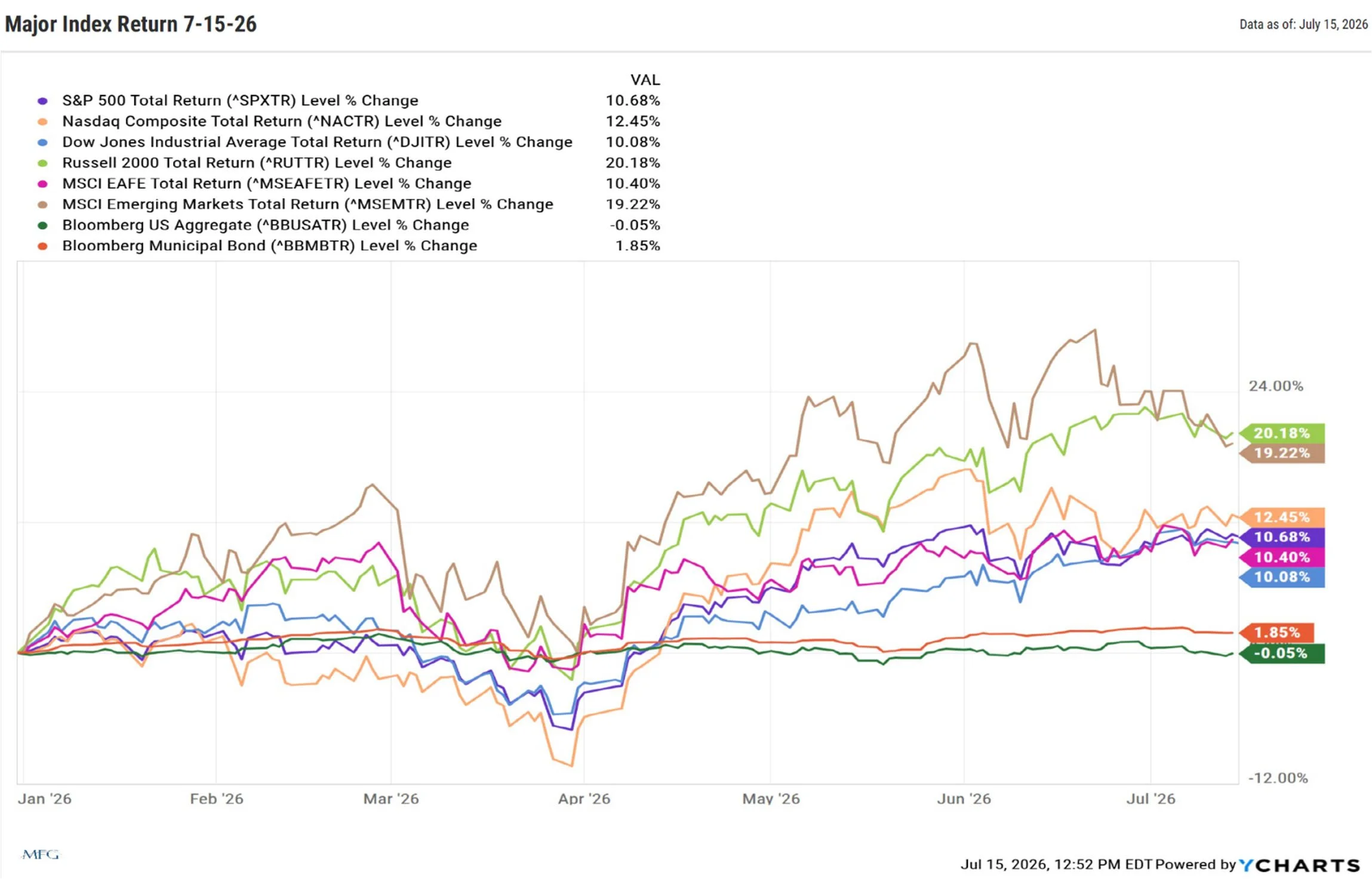
See below for year-to-date major indices performance (as of 7/15/26).
Relevant Topics: Trump Accounts & the ACA Cliff
By Ryan Robillard
Trump Accounts — A New Account Type for Minors
Established under The One Big Beautiful Bill Act (OBBBA), Trump Accounts are designed to give children an early and meaningful start toward retirement savings, while also encouraging broader financial literacy across families.
At their core, Trump Accounts function similarly to traditional IRAs, but with a critical difference — children do not need earned income to participate. This removes one of the biggest barriers that has historically limited saving into a Traditional or Roth IRA for minors and opens the door for parents, grandparents, and even institutions to begin investing on a child's behalf from birth through age 17.
From a planning perspective, the flexibility around contributions is one of the most compelling features. Families can contribute up to $5,000 annually, while employers may add up to $2,500 within that same limit. In addition, government and charitable contributions — such as the $1,000 federal contribution available to eligible children — do not count toward that cap, meaning total annual funding can exceed traditional thresholds. This layered contribution structure creates a powerful opportunity for early accumulation, particularly when paired with a long investment horizon.
Not all contributions are treated the same from a tax standpoint. Family contributions are made on an after-tax basis and establish basis in the account, meaning those dollars are not taxed again when withdrawn. In contrast, employer and government contributions, along with all investment earnings, are considered pre-tax and will be taxable as income upon distribution.
During what is known as the “Growth Period” (birth through age 17), these accounts are designed strictly for accumulation. Investment options are intentionally limited to low-cost, broad U.S. equity index funds, reinforcing a disciplined, long-term approach. Distributions are generally not permitted during this period, ensuring that the focus remains on compounding rather than short-term access.
Once the child reaches age 18, the account transitions into a structure that mirrors a traditional IRA. At that point, standard rules around contributions, distributions, and taxation begin to apply. Because contributions may include both after-tax (family) and pre-tax (government/employer and earnings) dollars, distributions are treated proportionally — meaning a portion may be tax-free, while the remainder could be subject to income tax and potential penalties depending on timing and use.
From a broader planning standpoint, Trump Accounts now join 529 plans and custodial (UTMA) accounts as part of the toolkit for saving on behalf of children. Each serves a different purpose. While 529 plans remain highly effective for education-specific goals — and offer clear gift tax treatment — Trump Accounts stand out for their retirement focus and ability to leverage outside contributions. For families considering both, evaluating them together rather than in isolation may help preserve flexibility as rules continue to evolve.
The real advantage lies in time. Starting an account at birth allows for decades of compounded growth, even with relatively modest contributions. In situations where a child qualifies for government or employer funding, the account may provide meaningful value even if families contribute little or nothing themselves.
As with any new legislation, details remain subject to evolving IRS guidance, and implementation will continue to develop. However, the underlying concept is clear: encouraging earlier engagement with saving and investing can have a meaningful long-term impact.
If you'd like to explore whether a Trump Account fits into your family's financial plan, we encourage you to connect with your advisor to initiate the discussion.
Affordable Care Act — Back to the Norm?
One of the most significant health care planning changes of 2026 has been the expiration of the enhanced Affordable Care Act (ACA) premium tax credits. After several years of expanded subsidies introduced during the pandemic, Congress allowed the provisions to lapse at the end of 2025, returning the ACA marketplace to its pre-COVID framework. As a result, millions of Americans are facing higher health insurance premiums this year.
Most notably, the ACA's “subsidy cliff” has returned. Under the enhanced rules, households could qualify for premium assistance regardless of income, with premiums generally capped at 8.5% of household income. Beginning in 2026, however, individuals and families with income above 400% of the federal poverty level once again lose eligibility for premium tax credits entirely, creating a sharp cutoff where even a small increase in income can result in the loss of thousands of dollars in annual subsidies.
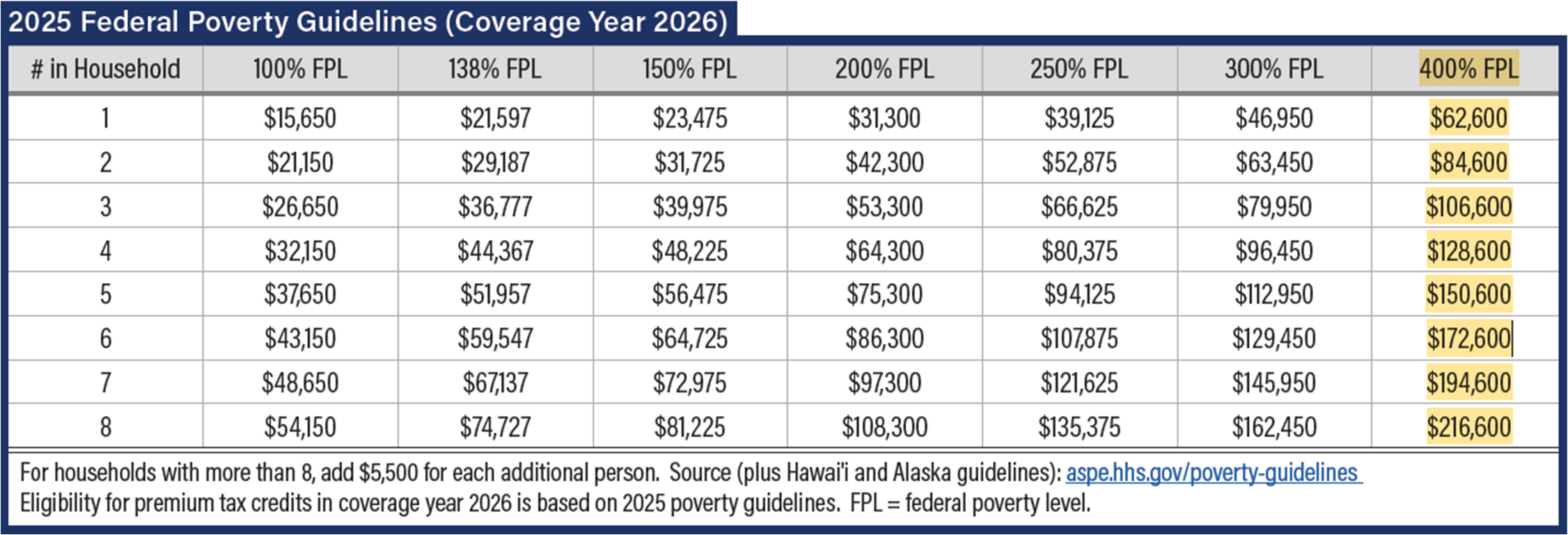
2025 Federal Poverty Guidelines (Coverage Year 2026). Source: Beyond the Basics Reference Chart / aspe.hhs.gov.
For early retirees, self-employed individuals, and pre-Medicare households purchasing coverage through the ACA marketplace, countable income management has become increasingly important. Strategies such as coordinating retirement account withdrawals, Roth conversions, capital gains, and Health Savings Account (HSA) contributions may help households remain below key income thresholds and preserve valuable premium assistance. As health care costs continue to rise, proactive tax planning is once again an essential component of managing overall retirement and household expenses.
The Economy: Where We Stand & What's Next
As we enter the third quarter and the remainder of 2026, there are a few items we are keeping in focus within the US economy.
Inflation & The Fed
The chart below highlights the ongoing tug-of-war between inflation and monetary policy, with recent inflationary pressures — largely driven by the Iran conflict and the associated spike in oil prices — pushing CPI back above the Fed Funds Rate. This dynamic suggests the Fed briefly fell “behind the curve,” meaning policy rates were not restrictive enough to keep inflation in check, a situation that can allow price pressures to become more entrenched and erode the Fed's credibility. However, June inflation data came in lower than expected, showing inflationary easing month-over-month and bringing CPI back slightly below the Fed Funds Rate, at least for now. This sets up a critical decision at the upcoming July 29th FOMC meeting, particularly with new Fed Chair Kevin Walsh leading the discussion. The Fed faces a delicate balancing act: while there may be political pressure from President Trump to continue cutting rates, the recent inflation data may suggest the opposite. Cutting too soon risks reigniting inflation, while holding firm reinforces the Fed's commitment to price stability — making this one of the more consequential meetings in recent memory.
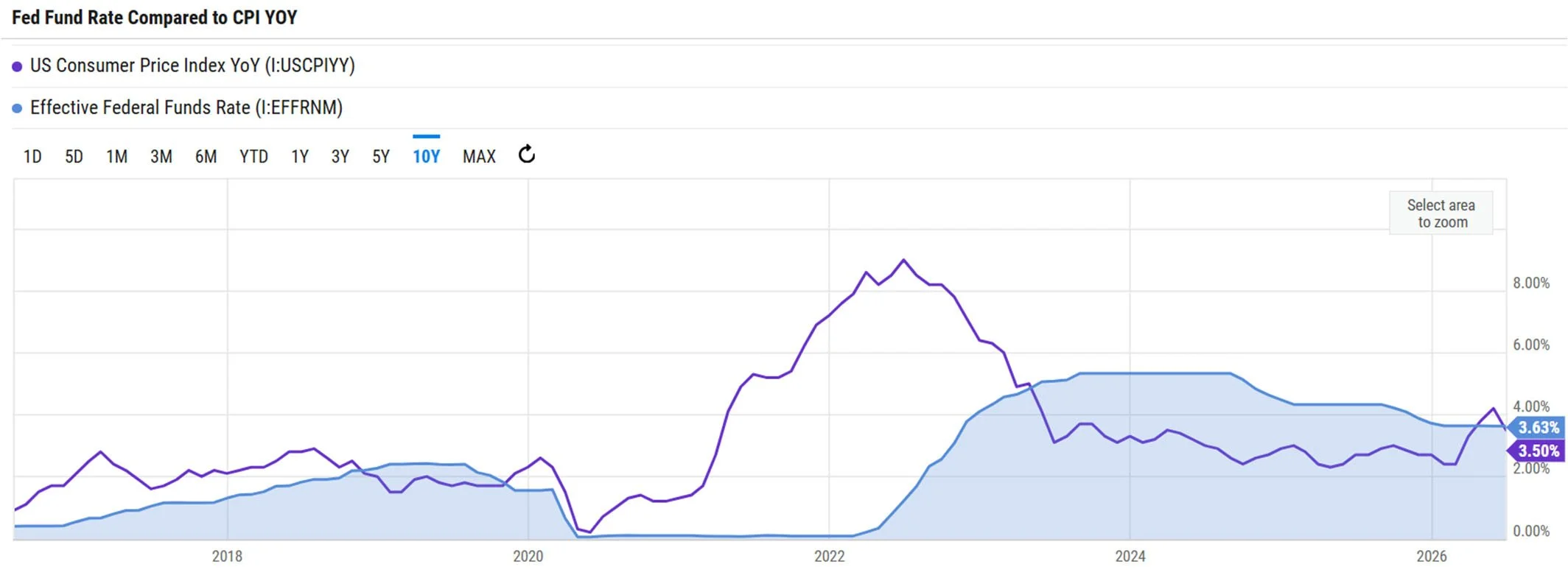
Effective Federal Funds Rate vs. US CPI (year-over-year), 10-year view. Source: YCharts.
Consumer Sentiment
It's hard to overlook consumer sentiment. Consumer sentiment continues to be a persistent concern in the post-COVID economic landscape, with confidence levels struggling to regain sustained momentum and repeatedly setting new lows. Most recently, sentiment fell again in May 2026, marking another weak point in an already fragile trend. Continued declines highlight ongoing consumer uncertainty. Consumer sentiment and spending remain key drivers of economic growth, and prolonged weakness may signal that households are increasingly cautious about their financial outlook. If consumers continue to downgrade their expectations, it could point to potential economic softening ahead. However, if external pressures such as inflation or policy concerns ease, there remains potential for sentiment to recover, as seen in past rebounds.
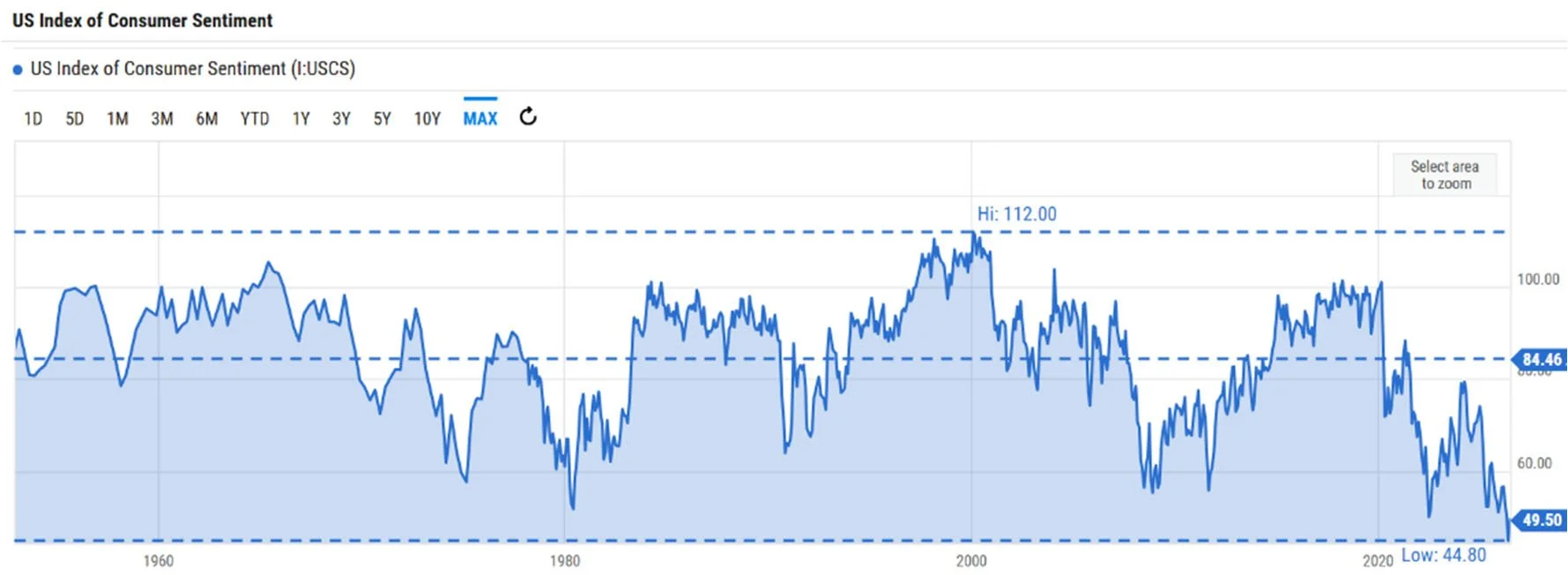
US Index of Consumer Sentiment, long-term view. Source: YCharts.
Real Wage Growth
The real wage growth chart shows how inflation-adjusted earnings have fluctuated over time, with periods of both strength and contraction. Notably, sustained negative real wage growth — where inflation outpaces wage increases — is typically a concerning signal for markets, as it erodes consumers' purchasing power and can lead to reduced spending, ultimately weighing on economic growth. Recently, real wage growth dipped into negative territory for two consecutive months (April & May), raising some concern about consumer resilience. However, it is encouraging to see that June inflation data came in better than expected, helping push real wage growth back into positive territory. This return to the “green” suggests that wage gains are once again outpacing inflation, which is a supportive sign for consumers if the trend continues.
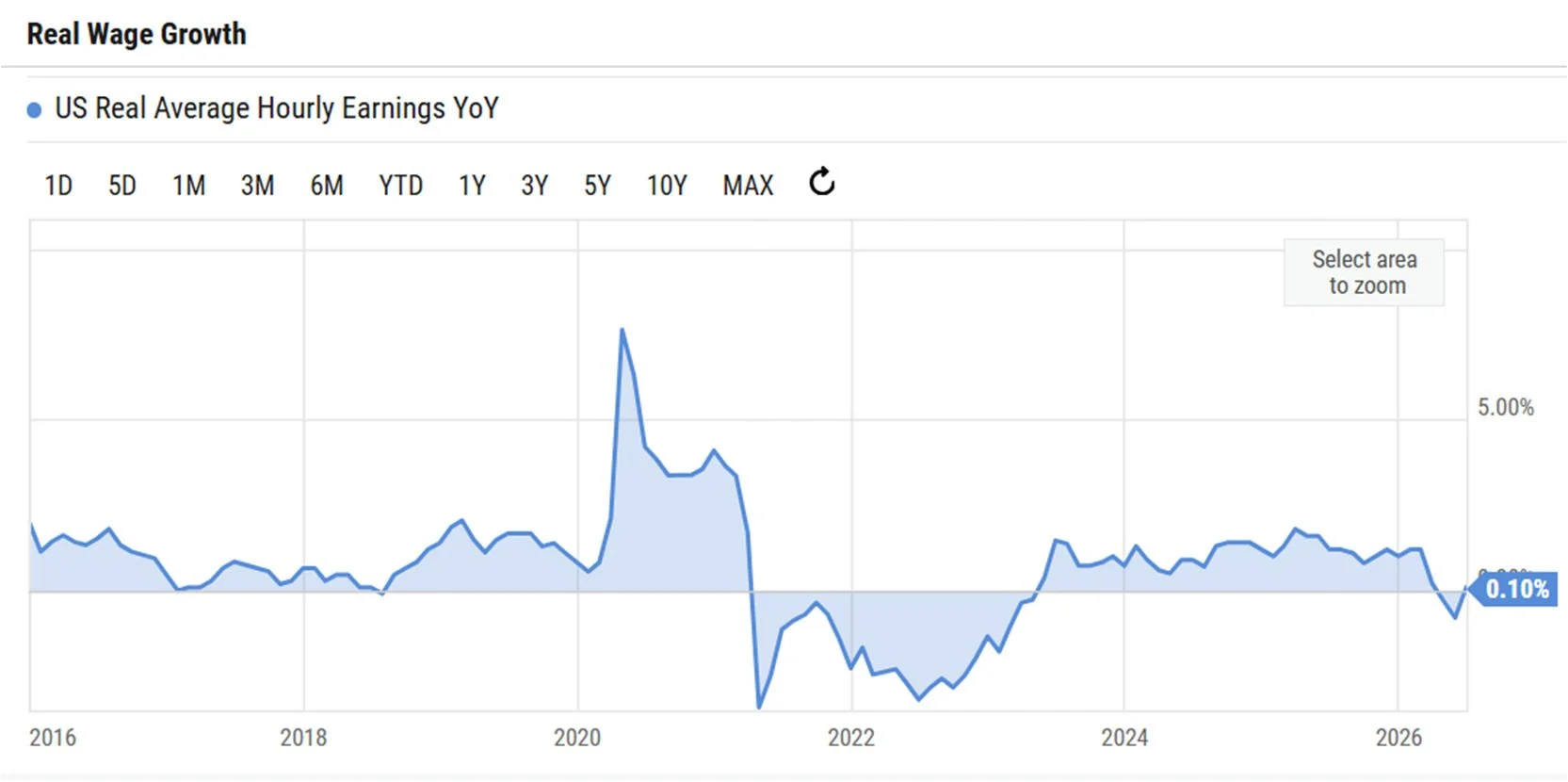
US Real Average Hourly Earnings, year-over-year. Source: YCharts.
US Savings Rate
The U.S. personal savings rate has recently fallen to its lowest level since 2008, signaling that consumers are saving less and spending a larger share of their income. This trend can indicate that households are feeling financial pressure from persistent inflation, higher interest rates, and rising living costs, forcing them to reduce savings in order to maintain their current lifestyles. While strong consumer spending can continue to support short-term economic growth, a declining savings cushion leaves consumers more vulnerable to economic shocks or unexpected expenses. If this pattern persists, it may point to weakening financial resilience among households and could eventually slow future spending, particularly if labor market conditions soften or borrowing becomes more expensive.
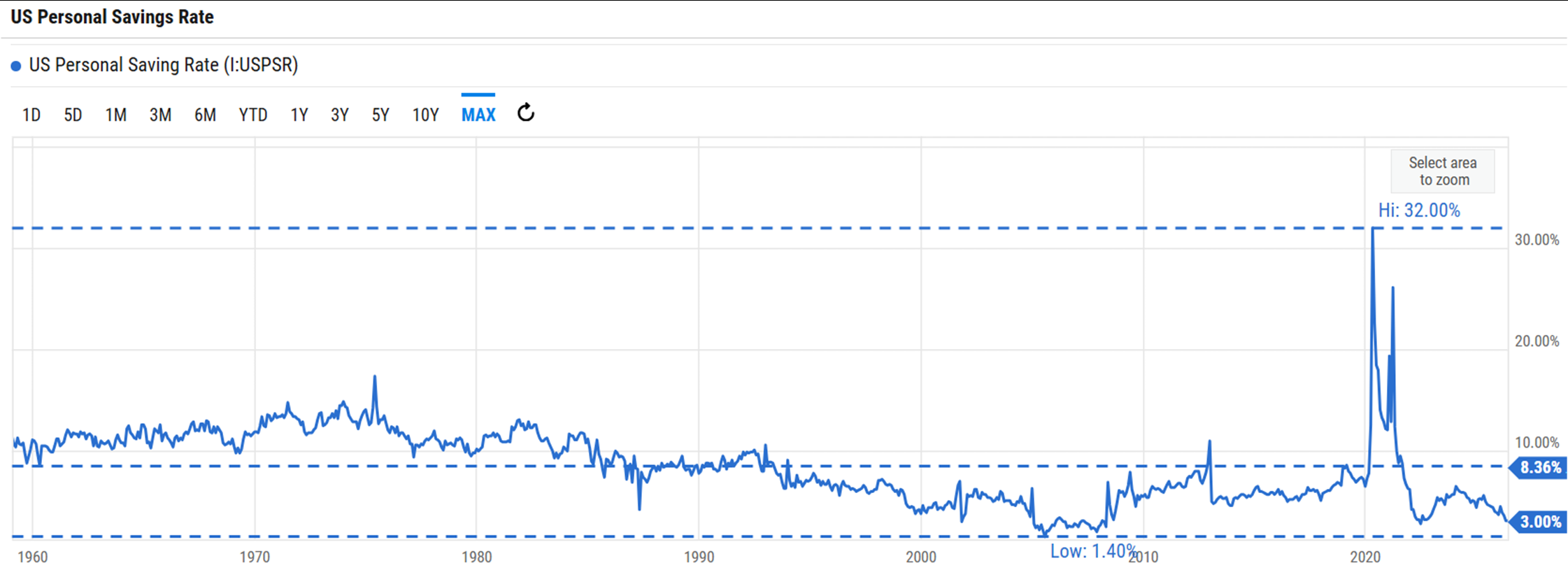
US Personal Savings Rate, long-term view. Source: YCharts.
Disclosure
Securities offered through Raymond James Financial Services, Inc. Member FINRA/SIPC. Any opinions are those of the author and not necessarily those of Raymond James. All opinions are as of this date and are subject to change without notice. The foregoing information has been obtained from sources considered to be reliable, but we do not guarantee that it is accurate or complete, it is not a statement of all available data necessary for making an investment decision, and it does not constitute a recommendation. Investing involves risk and you may incur a profit or loss regardless of strategy selected, including asset allocation and diversification. Past performance is not a guarantee of future results. References to portfolio positioning, investment committee decisions, asset allocation, or investment strategies are intended to provide insight into the firm's investment management process. Actual investment decisions and portfolio allocations vary based on each client's investment objectives, risk tolerance, financial circumstances, tax considerations, and other relevant factors. The S&P 500 is an unmanaged index of 500 widely held stocks that is generally considered representative of the U.S. stock market. The MSCI EAFE (Europe, Australasia, and Far East) Index is an equity index designed to measure the performance of developed markets outside of the U.S. and Canada. It includes countries in Europe, Asia, and the Pacific region. The NASDAQ Composite Index tracks the performance of more than 3,000 stocks listed on the NASDAQ Stock Market. The Dow Jones Industrial Average (DJIA) is a price-weighted index of 30 large, publicly owned U.S. companies. The Russell 2000 Index measures the performance of the 2,000 smallest companies in the Russell 3000 Index. The Bloomberg U.S. Aggregate Bond Index is a broad-based benchmark that measures the performance of the U.S. investment-grade bond market. The Bloomberg Municipal Bond Index tracks the performance of the U.S. investment-grade, tax-exempt bond market. It includes state and local general obligation bonds, revenue bonds, and pre-refunded bonds. Keep in mind that individuals cannot invest directly in any index, and index performance does not include transaction costs or other fees, which will affect actual investment performance. Individual investor's results will vary. Raymond James and its advisors do not offer tax or legal advice. You should discuss any tax or legal matters with the appropriate professional.

Why Health Savings Accounts (HSA's) are so Important
A little bit of planning can go a long way in avoiding taxes and having real world results when paying for medical expenses. Recently I experienced this after needing a significant amount of dental work that insurance wouldn’t cover. After diving deeper into Health Savings Accounts and utilizing some of these tax-saving strategies myself, I wanted to share this information.
Unless you are a CPA, financial planner, or tax nerd you probably don’t jump for joy when you think about taxes. Furthermore, almost no one likes having to plan for medical expenses. But a little bit of planning can go a long way in avoiding taxes and having real world results when paying for medical expenses. Recently I experienced this after needing a significant amount of dental work that insurance wouldn’t cover. After diving deeper into Health Savings Accounts and utilizing some of these tax-saving strategies myself, I wanted to share this information.
When it comes to tax advantaged saving, HSA’s are not always top of mind. 401(k)’s, Traditional IRA’s, and Roth IRA’s tend to draw more attention. I think this is a shame as HSA’s are what we like to call tax unicorns. The reason for this is additions to HSA account receive a federal tax deduction, grow tax free, and can be withdrawn tax free as long as the funds are used for qualified medical expenses. It’s almost too good to be true, never paying taxes on money that most Americans anticipate having to spend every year for medical expenses.
In addition to the tax benefits, employers sometimes match contributions to an HSA (up to certain dollar amount per year). In some instances, they will contribute a certain dollar amount regardless of your contributions as long as you are eligible and have an HSA opened. This is a great opportunity to get “free money” an employer is offering.
It’s important to note that HSA’s are similar to other tax advantaged accounts in that their annual contribution is limited and is perishable. Once you have filed your taxes for a given tax year, you can no longer make contributions to your HSA for that year. This indicates that whenever possible, we want to contribute to, or at least funnel expenses through the HSA. If you contribute more to the HSA compared to your expenses, the balance can be used in future years. This same feature is not available in other plans life Flexible Savings Accounts (FSA’s)2.
Ideally, we should plan on funding HSA’s with payroll deductions because of the tax benefits mentioned early. When HSA contributions are made with payroll deductions, not only do they provide a federal tax deduction, they also are not subject to FICA taxes. Not all HSA plans offer this additional layer of tax savings. However, most HSA’s are structured this way as it is usually the most advantageous for the employer as well3. This contribution method is similar to contributions made to a retirement plan as payments are deducted directly from your check and deposited into the HSA.
Alternatively, you can make contributions to your HSA directly from other sources. While slightly less advantageous, the federal tax deduction benefit is still available. Let’s say you have a $1,000 medical expense, $0 in your HSA, but you have the $1,000 set aside in your savings account. You can contribute that $1,000 to your HSA, pay for the medical expense from the HSA via an issued debit card, or “reimburse” yourself the funds and pay for the medical expense a separate way. The concept is to create the tax deduction by contributing to the HSA, and then documenting that you used the HSA money for a qualified medical expense.
What is the hard dollar benefit for utilizing an HSA in this way? Ultimately it depends on what tax bracket you fall into is for any given year. But for illustrative purposes, let’s assume you are a couple making $115,000 with no other deductions except the standard deduction of $24,400 (in 2019). Your adjusted gross income would place you in the 22% marginal tax bracket. Therefore, a $1,000 deduction would in theory save you $220 in federal income taxes.
For this same hypothetical situation, if a family was able to max fund an HSA for a given year, you would receive a 7,100 deduction2 (2020 annual contribution limit). Using the scenario illustrated above, that would equate to a roughly $1,562 reduction in federal taxes. If those funds were also contributed solely through payroll deductions, an additional $543 in FICA taxes could be avoided. Combine these two taxes savings and you have $2,105 in hard dollar tax savings. Furthermore, tax savings may exist on a state level as well. However, because Health Savings Accounts are a federally mandate program, states can choose to comply with the federal guidelines or make their own rules2.
Most HSA plans also include an investment component once the balance hits a certain dollar amount ($2,000 for example). Once reached, you can begin investing any dollars over the requirement. HSA account plans will often offer an investment lineup similar to a 401(k) that you can choose from. Please Note: investing in an HSA can add a layer of complexity that may be too much to manage at first. It’s always prudent to make these decisions with an additional level of caution. If you anticipate needing the funds within a relatively short time frame, it’s likely best to leave it in cash or use a low risk investment vehicle like a money market mutual fund.
HSA’s do add some extra work when filing your taxes. However, if you work with a CPA, the required forms are common. If you file your own taxes, most major tax prep software has easy to understand modules that help you file your HSA related forms correctly.
Hopefully by you now see why Health Savings Accounts can be so beneficial. You get the best of both worlds when it comes to taxes, it’s a great way to practice saving for medical expenses, and if you are able you can put your money to work through investments. Understandably, there are lots questions that come up when using an HSA that require detailed answers. For the most accurate and up to date information visit: https://www.irs.gov/publications/p969 This page can be daunting as it stores a lot material that may not be relevant to you. However, it offers the best information out there about HSA’s.
Andrew Froelich
CERTIFIED FINANCIAL PLANNER™
Sources:
1 https://www.optumbank.com/all-products/hsa/hsa-eligibility.html
2 https://www.irs.gov/publications/p969
3 https://www.hsaedge.com/2018/09/23/reduce-social-security-and-medicare-taxes-with-an-hsa/

Social Security, The Chance to Make a Huge Mistake
Think of Social Security as an asset to be managed. It may be a bit of an abstract thought since it is impossible to call up Social Security and ask for a withdrawal. Still, the lifetime value of your Social Security benefit is likely to be substantial, and can be dramatically larger or smaller depending on your claiming strategy, timing, and longevity.
In my role as a financial planner, I interact with people at various stages of life. If I were to categorize these stages in retirement planning terms, in very rough terms, there are four: pre-accumulation, accumulation, transition, and retirement. Each stage is important and has certain common features and needs, but the mistakes that we see tend to be concentrated in the transition years.
We’ve often referred to the transition years as the Retirement Red Zone, in a reference to the NFL Red Zone, the last 20 yards to the goal line. There’s extra pressure and anxiety, just like in the NFL. We typically can sense that anxiety in clients around 5-7 years before retiring from full time employment, and it often extends into the first year or two of retirement. And why would that be? There are a number of anxiety factors outside of money, including change of social network and purpose, but money always plays a major role. The major source of income is soon going to be shut off, and how will you comfortably and reliably fill that gap?
There is a lot going on, and clients often feel that something has to be done. A solid Retirement Income plan should consider pensions, portfolio positioning in extreme detail, reliability of expected returns, liquidity, order of asset use, tax planning, part-time employment, inheritance, gift planning, and of course, Social Security.
I tend to think about Social Security as an asset to be managed. I am not sure that other people do, however, since it is impossible to call up Social Security and ask for a withdrawal. Still, the lifetime value of your Social Security benefit is likely to be substantial, and can be dramatically larger or smaller depending on your claiming strategy, timing, and longevity.
There is one misunderstanding that comes up frequently. Clients and Prospective clients often indicate that they intend to quickly fill the lack of employment income with Social Security. I suspect that it feels better emotionally to have the money coming in. Digging deeper, some clients have mentally combined their desired retirement date with their intention of when to claim Social Security, as a single point in time.
However, after we do our planning work, very few of our financial plans show claiming Social Security early as the best result. It is quite common for the optimal claiming strategy for a married couple will show $300,000 or more in additional projected lifetime benefits over and above the worst claiming strategy. More often than not, claiming at age 62 is the worst strategy available. Yet, for Americans as a whole, age 62 is the most popular filing age. Interestingly, since the 1980’s, about 2/3rds of the population has claimed social security before their FRA, with about half claiming it as soon as possible. https://www.ssa.gov/policy/docs/ssb/v74n4/v74n4p21-text.html#chart1
In real dollar terms for a person in their early 50’s, if your Social Security benefit was $3,000 per month at a Full Retirement Age of 67, you could choose to take your benefit at 62 for about $2,100, or wait until age 70 and receive $3,720, or some number and age in between. Roughly speaking, the benefit has a guaranteed increase of 5-8% per year, plus cost of living adjustments. https://www.ssa.gov/policy/docs/ssb/v74n4/v74n4p21.html
For many clients, we encourage preserving and growing the Social Security benefit for a later date, while using other assets to cover retirement spending in the meantime. I want to be very clear that this general statement is not a prescription for you, as differences in family longevity, health, spouse ages and incomes, prior marriages and deaths, and other factors can all affect your projected benefits, as well as your overall retirement income plan. We go through a lot of discussions, planning, and projections before making a recommendation to any client. Still, the truth is that in our current low interest rate environment, it is rare to find another investment that has a guaranteed increase of 5-8% per year plus a cost of living adjustment.
If you follow this thought to its logical conclusion, for a client to delay claiming Social Security, they have to live on something else for several years, and that can feel uncomfortable. If you are like most, the short story is that you may need 3-8 years or so of providing for your own expenses, during the first, best, and often most expensive retirement years. Let’s face it, you are likely to travel and consume much more entertainment in your 50’s and 60’s than your 80’s or 90’s. Unless you have a pension, generally you have to live mostly off your investments. Of course, it might be fun to pick up part-time work as a supplement, often as a “near-hobby.” Like gardening? Work at the flower shop or garden center. Like guns? Work at the shooting range.
Living nearly completely from a portfolio for a few years often requires uncomfortably high portfolio withdrawal rates. It is not uncommon to be withdrawing 7%, 8%, and sometimes more, per year for a few years. This situation would be completely unsustainable were it not for the relief when Social Security is switched on, at the higher monthly amount. When planned correctly, the Social Security benefit replaces most of the withdrawals and reduces the strain on the portfolio, so that the withdrawal rate is often below 3%, sometimes below 1% after Social Security is on. It is not unusual for a financial plan to show dwindling assets up to the age at which we turn on Social Security, and accumulating assets afterward.
One caveat is that Social Security benefits may change over the next few years, as Congress addresses the financial reality of the future of the program. We’ve addressed that in the past, and regardless of what happens, the benefit will still be significant enough to think carefully about.
There are several other important details to get right during the transition years, and every detail is interwoven with the next. Today I have touched on Social Security, and the importance of getting it right as one element of prudent retirement income planning. As a quick reminder, a solid plan should consider portfolio positioning (in much greater detail than most advisors provide), reliability of expected returns, liquidity, order of use relative to tax planning, inheritance and gift planning, all coordinated with Social Security. That’s what we do well. If you want to chat about it, feel free to call or email me: patrick@maccofinancial.com.
Please note, changes in tax laws may occur at any time and could have a substantial impact upon each person's situation. While we are familiar with the tax provisions of the issues presented herein, as Financial Advisors of RJFS, we are not qualified to render advice on tax or legal matters. You should discuss tax or legal matters with the appropriate professional. Keep in mind that there is no assurance that any strategy will ultimately be successful or profitable nor protect against a loss. Investors should consider their personal investment horizon and income tax brackets, both current and anticipated, when making an investment decision, as these may further impact the results of the comparisons. Keep in mind that results will vary as investing involves risk, fluctuating returns, and the possibility of loss. The foregoing information has been obtained from sources considered to be reliable, but we do not guarantee that it is accurate or complete, it is not a statement of all available data necessary for making an investment decision, and it does not constitute a recommendation. Any opinions are those of Patrick Stoa and not necessarily those of Raymond James. Links are being provided for information purposes only. Raymond James is not affiliated with and does not endorse, authorize or sponsor any of the listed websites or their respective sponsors. Raymond James is not responsible for the content of any website or the collection or use of information regarding any website's users and/or members.

The Importance of Proper Income Tax Withholding
Would you rather have a dollar today or a dollar tomorrow? What about one dollar every month or twelve dollars at the end of the year? The majority of us would take the money as soon as possible. This is based on two old economic principles; opportunity cost and the time value of money. We know that having a dollar today rather than some time in the future is more valuable because it means we can use that dollar immediately. This could mean saving, paying off debt, or even investing it for the future. Therefore, as we evaluate something of equal value received in the future, we discount its worth and prefer that same value now. This is relevant to us as taxpayers as every month we are given the option to receive more now or more when we file our taxes (assuming we are withholding too much).
Would you rather have a dollar today or a dollar tomorrow? What about one dollar every month or twelve dollars at the end of the year? The majority of us would take the money as soon as possible. This is based on two old economic principles; opportunity cost and the time value of money. We know that having a dollar today rather than some time in the future is more valuable because it means we can use that dollar immediately. This could mean saving, paying off debt, or even investing it for the future. Therefore, as we evaluate something of equal value received in the future, we discount its worth and prefer that same value now. This is relevant to us as taxpayers as every month we are given the option to receive more now or more when we file our taxes (assuming we are withholding too much). And while its obvious to us to take the dollar today versus tomorrow, a 2011 study found that the average federal refund in the state of Wisconsin was $2,462.89. We are no longer talking about a dollar every month but rather $205! That’s a meaningful difference and one that we should not quickly ignore. Sizable tax refunds can be used for good things like paying off debt or saving. But more often than not they are used for less noble options, despite our best intentions. What then can we do to remedy the situation and get funds back in our monthly budget?
There are a couple of ways to make sure your withholding is as accurate as it can be. The first step is to visit the IRS’s Withholding Calculator. You will need annual income figures, a copy of a your most recent pay stub(s), how much in taxes you have paid so far in the given tax year, and your portion of employer sponsored plan contributions (401(k) 403(b) etc..). The calculator works best if your situation is relatively simple, one or two incomes along with only a few dependents. However, if your situation is more detailed than that, you can still get a good reading from the calculator but having all the relevant figures will be even more important. See the screenshots for more tips when filling out the calculator.
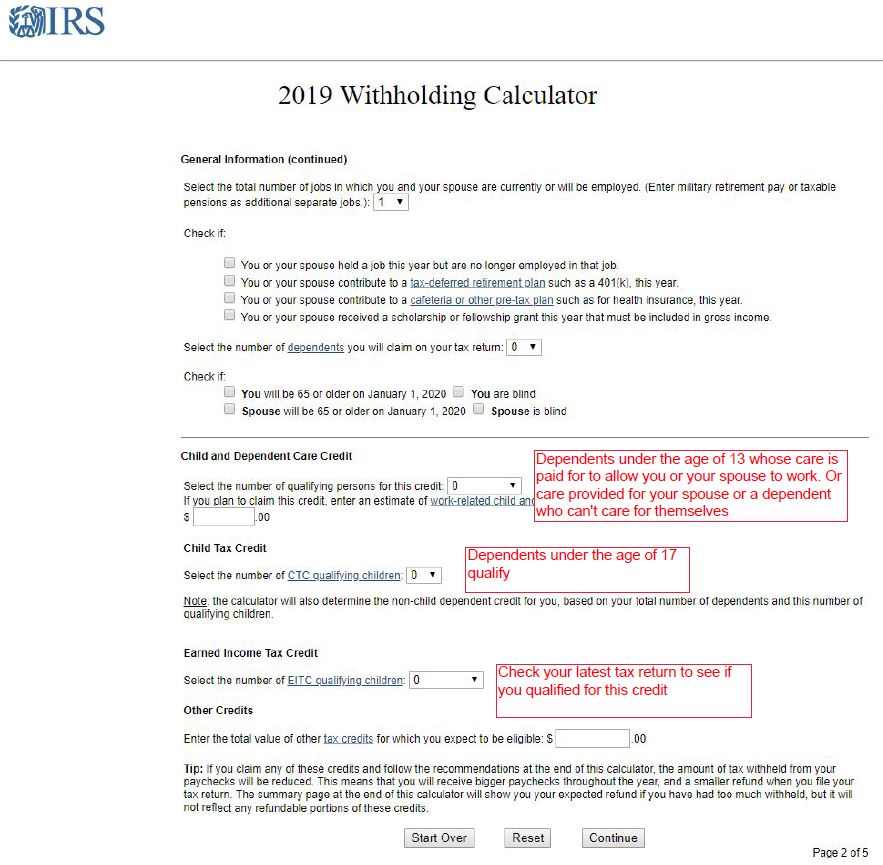
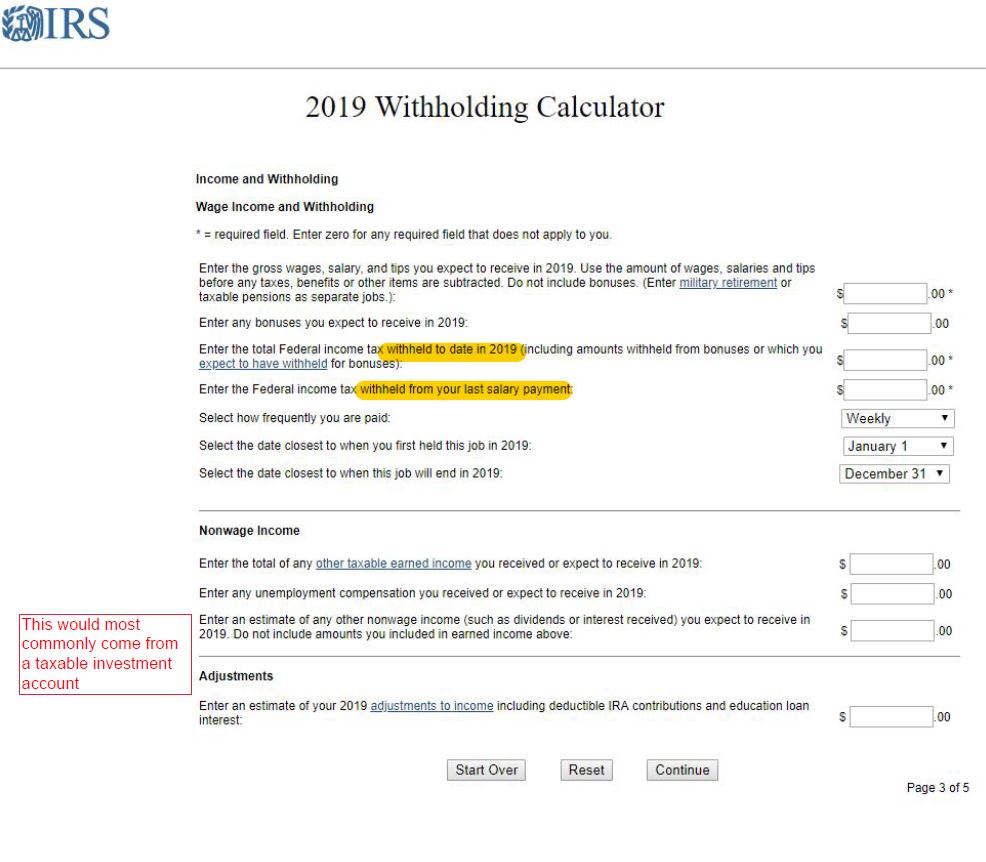
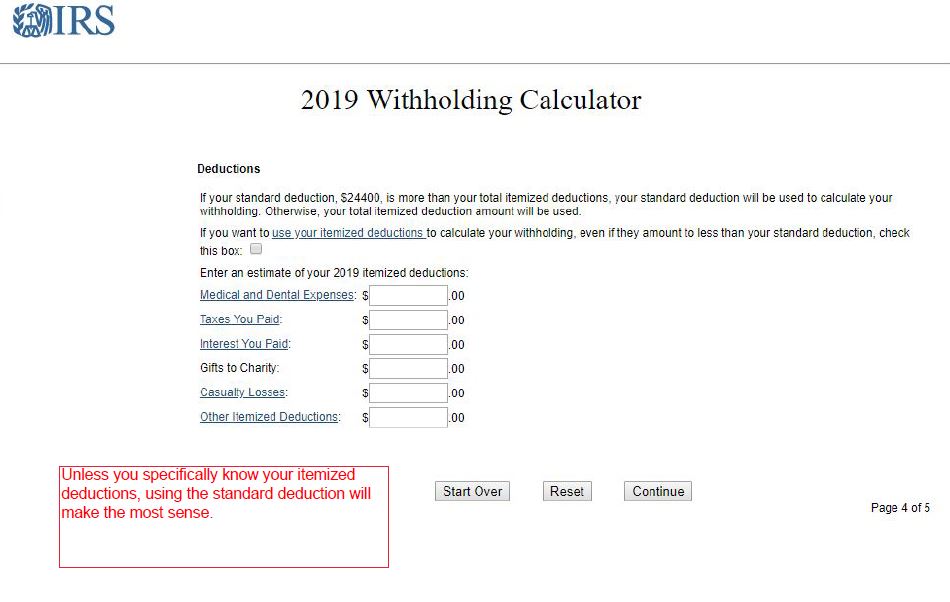
Once you have completed the calculator, you will have a good reading of where you stand for the given tax year. The next task is to complete the IRS’s W-4 worksheet. This is a somewhat duplicative job, but it is also a good proof of your work as it should result in the same recommended allowances as the calculator. If you have a dual income household, make sure you also complete the two earners worksheet on page 4. The end result of completing the W-4 and withholding calculator may mean you need to modify you existing allowances. You will need to work with your employer to adjust the number of allowances you claim. This figure comes from page 1 of the W-4 (see W-4 screenshot below). Some employers may require you to sign and submit this completed W-4 while others are able to make the change without it.
After you have worked with your employer to update your allowances, it’s important to allow 1 or 2 paychecks to flow through the updated withholding. This will produce new figures for how much is taken out of each paycheck for taxes. With these new figures in hand review your work once again. This can be done by redoing the withholding calculator based on the amounts withheld from your latest paycheck and the new amount withheld year to date (see withholding calculator page 3). You can also check your work by extrapolating one month’s withholding into twelve and checking the final figure with your previous year’s taxes paid (make sure to take into account any increase or decrease in earnings as well as fluctuations in pay from month to month, if your compensation is not level). Based on the results of this final check, you can either revise your allowances by repeating the prior steps or continue to withhold at the new amount, if the numbers are correct. By knowing these numbers, you will have a better feel for how your taxes will shake out for the following year. Tax withholding is not an exact science and everyone’s situation is unique. This may mean having to dreadfully “pay in”. But if you can see it coming, hopefully you will be more prepared.
So why go through all of the work if you are going to get the money at the end of the year anyway? I alluded to this point in the opening paragraph. Monthly cash flow is the basis upon which most of us budget and how we direct normal spending. To have the most effective and efficient budget, we need to correctly account for tax withholding. Let’s use the above-mentioned average as an example. If we received $205/mo. and applied that to debt reduction (assuming a $10,000 balance, interest rate of 5%, and a 5-year period) we would be able to pay the loan off almost 6 months earlier when compared to using the same dollar amount but only once per year. And while it’s also true that you are making an “interest free loan to the government” by over withholding, proper tax withholding is less about them and more about you. “With great power comes great responsibility”. Adding these funds back into your monthly budget will mean that every month you will need to be disciplined to make sure that money goes towards its intended purpose.
If you think that this is just too much work, the good news is the IRS has done some of this work for you. A couple articles have run in the last few weeks reporting that Americans are receiving smaller refunds for 2018 compared to previous years. Here is an example from CNBC “Here’s why the average tax refund check is down 16% from last year”. As the article points out, this had been due in part to the fact that Americans are receiving more in wages on a monthly basis and less at the end of the year from a tax refund. This is good news for all of us! It means the IRS has already done a better job of estimating our taxes based on the tax law changes enacted in 2017. While this is a good start, I would still encourage you to look at your own withholding and do the work to see if any changes need to be made.
Andrew Froelich
Financial Advisor
https://www.governing.com/gov-data/finance/average-irs-tax-refund.html
https://www.cnbc.com/2019/02/22/heres-why-your-tax-refund-could-be-smaller-than-last-year.html
While we are familiar with the tax provisions of the issues presented herein, as Financial Advisors of RJFS, we are not qualified to render advice on tax or legal matters. You should discuss tax or legal matters with the appropriate professional. Any examples are hypothetical and for illustration purposes only. Actual results will vary.

What does Fiduciary mean, and why does it matter?
Almost all our engagements and recommendations with clients are Fiduciary. Why does that matter to you? Under current regulations, all advisors are now required to act as Fiduciaries for new recommendations in retirement accounts (for example IRA accounts). However, they were not required to do that until very recently, and your account might be grandfathered under the old, weaker, “suitability” rules.
You may have heard the term fiduciary. Perhaps you even have a sense that there is something important about it, but you are not quite clear on exactly what it means or why it is important. Let’s help you with that, starting with a little history.
The story of this word probably started at the dawn of humanity, but we can knowingly document it’s conceptually history back to about 3,800 years ago, with the Code of Hammurabi (Circa 1790 BC). Within the Code, about half of the laws dealt with trade, liability, and care of other’s property. Later, Aristotle gave input in the mid 350 B.C. The concept of Fiduciary was solidified in Roman Law. Cicero (106 B.C. to 43 B.C) was quoted as saying:
“Therefore, legal proceedings for betrayal of a commission are established, involving penalties no less disgraceful than those for theft. I suppose because in cases where we ourselves cannot be present, the vicarious faith of friends is substituted; and he who impairs that confidence attacks the common bulwark of all men and, as far as depends on him, disturbs the bonds of society. For we cannot do everything ourselves; different people are more capable in different matters” (“Oration for Sextus Roscius of America”).
In it’s current form, the word Fiduciary comes from the Latin rood Fiducia, which means “trust, confidence, assurance, and reliance.”
With the very rich and deep history, it is safe to infer that the fiduciary is fundamental to human nature. The word has been put to the test through court cases in many jurisdictions, with predictably similar results. Arguably the current standard in the United States is best represented by the Uniform Prudent Investor Act of 1994. Technically this act is model legislation, and not a uniform law. However, the Uniform Prudent Investor Act or the similar Uniform Trust Code, are widely adopted in several states, and referred to by the courts frequently. In particular, it is instructive to view the Duties that are inherent in the Uniform Prudent Investors Act.
Here we will comment on these duties, but do so with a filter towards the financial advisory business, rather than being a Trustee. The two duties that shine through are:
· Duty of Care (or Standard of Care) - the duty to make reasonable decisions based upon proper due diligence. In plain English, this standard asks the question: “Would a person, of similar responsibility and professionalism, find the recommendations and actions made to be reasonable, given the same available information.” I think it is important to reiterate that this duty requires due diligence. Not asking basic questions about a client’s situation would be a failure of this duty, as would placing clients in strange or concentrated investments without a good reason to do so.
· Duty of Loyalty – the duty to place the client’s interest as primary. If there are conflicts, they must be avoided and/or reduced, and they must be disclosed. If a trustee, or an advisor, recommends something because of their own benefit, that is a conflict. The advisor must attempt to be impartial in their dealings.
There are other named duties in the act, such as to diversify, to control costs, and to monitor, although each of these can be inferred from the Duty of Care.
Almost all our engagements and recommendations with clients are Fiduciary. Why does that matter to you? Ironically, many advisors were not required or did not follow a Fiduciary standard. Under current regulations, all advisors are now required to act as Fiduciaries for new recommendations in retirement accounts (for example IRA accounts). However, they were not required to do that until very recently, and your account might be grandfathered, with some specific exceptions, under the old, weaker, “suitability” rules.
We have seen situations where people have come to us to “fix the mess” from other advisors. In the last year we have seen prospective clients with portfolios that were inappropriate for a variety of reasons, including portfolios that were too aggressive, very illiquid, over-concentrated in certain sectors, or locked up in products with high surrender fees. None of these situations would have passed a fiduciary standard. Unfortunately, they were all sold by someone following the lower suitability standard.
We’d love to implement your financial plan with the diligence and process that a fiduciary standard calls for. If you have any questions, please feel free to reach out to us.
- Patrick Stoa

College Planning: Grants, Work-Study, and Loans
In our prior videos (College Planning), we have talked about ways to reduce the cost of education through AP course, college selection, and scholarships. Assuming you have done that and still have a shortfall, you are probably moving on to methods of obtaining financial aid. Today we are going to talk about the $150 billion in federal aid that the US Department of Education offers to 15 million students each year. The aid is provided in the form of grants, work-study, and loans.
In our prior videos (College Planning), we have talked about ways to reduce the cost of education through AP course, college selection, and scholarships. Assuming you have done that and still have a shortfall, you are probably moving on to methods of obtaining financial aid. Today we are going to talk about the $150 billion in federal aid that the US Department of Education offers to 15 million students each year.
Before getting into it, there is a common form that most students and parents will fill out, called the FAFSA (link), or the Free Application for Financial Student Aid. If you have your tax and investment documents together, the FAFSA form is neither difficult nor time consuming to complete. The FAFSA form calculates something called the Expected Family Contribution (EFC). The EFC is exactly as it sounds: the amount that the parents and child are expected to contribute toward the child’s educational expenses for that year. It is worth noting, that many states including Wisconsin (link), also have aid forms available, that you probably should also fill out to attempt to receive their aid.
Each college you are considering has their own number called the Cost of Attendance (COA). Quite simply, if the COA is higher than the EFC, then you have a reasonable likelihood of receiving some form of financial aid. The aid can be awarded in grants, work-study, or loans.
Grants of course are the most attractive, because they don’t have to be repaid. If some of your aid comes as grants, rejoice! Quite simply, however, there is not enough money to go around to make it free for everyone.
That means we move on to work-study programs. The ideal work-study job is one in which little actual work needs to be done. My favorite example is the parking lot attendant. Perhaps a car leaves every 15 minutes or so, where you need to accept payment, which takes perhaps 30 seconds. Then you have another 10-20 minutes to be reading or studying before the next car comes along. This is an ideal situation – the employer needs someone there, but the work only happens intermittently.
Last, loans. Let me caution you here. Loans dig a deeper hole. As of 2015 here in Wisconsin, for students that take loans, the average loan balance is $29,000 at graduation(1). Nationwide, former students owe $1.26 trillion(2). With that in mind, I want to reiterate how important it is to be sure that the courses and majors you are pursuing are likely to have a reasonable career with an income that can support your student loan repayment, along with your other goals. I am personally aware of someone that spent $200,000 on an undergraduate degree that they are not using and will not use. I don’t know the exact amount that was borrowed, but surely some of it was. That was clearly a poor use of that money, essentially a 4 year expensive vacation from reality.
Take note that some loans are federally subsidized, which at ground level means lower interest rates, payments delayed until you graduate or leave school, and in some careers may mean partial loan forgiveness. Private (non-subsidized) loans, on the other hand, have much less favorable interest rates and payment terms.
To sum it up, be sure to do the FAFSA to take a shot at receiving aid.
Warmly,
Patrick Stoa
Financial Advisor
[1] $29,000 per WI student: http://ticas.org/posd/map-state-data
[2] $1.26 Trillion total: https://www.newyorkfed.org/microeconomics/hhdc(2nd chart with the detail of the Non-Housing Debt Balance, Q1 2016
Links are being provided for information purposes only. Raymond James is not affiliated with and does not endorse, authorize or sponsor any of the listed websites or their respective sponsors. Raymond James is not responsible for the content of any website or the collection or use of information regarding any website's users and/or members.

College Planning: Athletic, Academic, Community, Specialty, and Workplace Scholarships
In our first college planning video, we highlighted advanced placement credits, college selection, and military scholarships. Today we are going to talk about other scholarships: athletic, academic, and community/specialty/employer scholarships.
In our first college planning video, we highlighted advanced placement credits, college selection, and military scholarships. Today we are going to talk about other scholarships: athletic, academic, and community/specialty/employer scholarships.
First of all, let’s talk about something that many athletes dream about: The Full Ride. I hate to burst your bubble, but it is not common at all. First of all, Division 3 schools cannot give athletic scholarships. Likewise, Division 1 and 2 schools are typically limited in how many scholarships they can give out per sport. The reality is that they have far fewer to give than they have athletes. So, even if offered, it is quite common for scholarships to be partial scholarships.
Still, if you can get a partial scholarship to do something you like doing, that’s great. Partial scholarships are still great way to cut down on college costs. One of the key things we learned through our daughter pursuing an athletic scholarship is that the coaches want to communicate with the athlete, and not with the parent. The coach and the athlete are the ones that will be practicing together for 4 years, so they have to develop the relationship.
One dilemma: does the school offering the athletic scholarship have the expertise in your desired major(s)? How about your plan B, what if you change your mind partway through and want to go to a different field of study. It happens, a lot. Another thing to consider is that practice and competition schedules are priority number one, so working to supplement your income may be difficult. Social life can be different if your team practices at 6am most days.
Let’s move on to Academic Scholarships. These are great if you can get them. Basically, you are being rewarded for being a good high school student. Typically there is an application of some sort, with grades, test scores, outside activities such as service hours, and an essay taken into account. In some cases, you can submit one application for multiple scholarships. I am mixed about the benefit of a single application for many scholarships. Yes, you easily applied for several, but so did everybody else, and the money is not unlimited. So you are not ahead. Sometimes your school of choice will offer scholarships to applicants who meet certain criteria. For example, at the University of Alabama, high test scores and a high GPA can earn you full tuition even for out of state students. They are not alone in this.
Lastly, let’s talk about Community, Specialty and Workplace scholarships. These can be scholarships that are available to a more limited number of people. Typically to be eligible, you have to live in a certain area, be going into a certain field of study, maybe be in a certain club or activity, or have parents that are employed by a certain company. A well-known example of what I call a specialty scholarship is the Evans Scholar program for golf caddies. As far as workplace scholarships, in our area I am aware of several large employers that give scholarships of $500 to $1,000 a year for children of employees. These are not well advertised, and sometimes you have to actively search for them. The nice thing about these types of scholarships is that far fewer people apply for them, so your odds of being awarded the scholarship go up dramatically.
Best of luck with scholarships. Next time we are going to talk about financial need programs and FAFSA, along with work studies and student loans.
Respectfully,
Patrick Stoa
Financial Advisor.
patrick@maccofinancial.com
Links are being provided for information purposes only. Raymond James is not affiliated with and does not endorse, authorize or sponsor any of the listed websites or their respective sponsors. Raymond James is not responsible for the content of any website or the collection or use of information regarding any website's users and/or members.

College Planning: Advance Placement, College Selection, & Military Benefits
Does the potential cost of college have you worried? Today we are going to talk about ways to plan for college costs. There are several ways, but we are going to focus on 3 that I think you can control. This is near and dear to me as I have 6 kids, with the first one just entering her 2nd year of college. Possibly 5 more to go, so I appreciate any avenue to save money while still getting a good value in this area.
Does the potential cost of college have you worried? Today we are going to talk about ways to plan for college costs. There are several ways, but we are going to focus on 3 that I think you can control. This is near and dear to me as I have 6 kids, with the first one just entering her 2nd year of college. Possibly 5 more to go, so I appreciate any avenue to save money while still getting a good value in this area.
Personally, I think the overall strategy for college planning should be one of pursuing a good return on investment for the time and money spent on college. There are really two ways to get a better return on investment – either lower the amount invested, or increase the return. Today we are talking about lowering the amount invested, making it easier to afford to go. We are also going to stick to the things that are almost completely within your control – advanced placement credits, college selection, and military benefits. In a later video we will talk about some things that are nice, like scholarships, but not completely in your control.
Early on, long before a child is selecting a college, you can start to reduce your potential college costs through courses known as Advanced Placement courses your high school may offer. In our case, our local high school offered “AP” courses starting as early as sophomore year. How the basic AP courses work is that the child takes the course at their high school, and at the end of the year they sign up for a test for about $100. If they do well enough on the test, then many colleges will accept that as completed college credits. For example, my oldest daughter left high school with more than a full year of college credits (about 30 credits). The total cost for this was maybe around $1,000. Think about that. That boost allows her to get into higher level courses sooner, and likely get a double major in the same time that others would get a single major. What’s the downside? Not every college accepts the credits. The colleges least likely to accept the credits seem to be the prestigious schools, such as some of the Ivy League schools. However, most of the state schools do allow for AP credits.
Likewise, college selection makes an enormous impact on total cost. The average published tuition cost for local 2 year colleges is about $3,500 a year, compared to around $32,000 for private 4 year colleges. Public Universities are in the middle, around $9,500 for in state students in around $24,000 for out of state students. To help students and their families calculate these costs, many colleges have net cost calculators available on their websites. These calculators will ask a number of questions regarding your situation, let you know of certain scholarships that you may automatically qualify for based on factors such as GPA, SAT or ACT test scores, and analyze your financial situation giving you an estimate of expected aid to help determine what the rough net cost will be. The net calculators are important, since several of the private schools with quite large published tuition rates, will regularly discount to attract good students.
The last of the controllable costs is military benefits. The reason I am including them is that, for the most part, healthy young high school graduates could take advantage of them. And the benefits are quite significant. There are two basic benefits, the first being ROTC, or Reserved Officers Training Corps, and the second being the GI bill. The ROTC program is quite good. It varies by branch, but typically ROTC will pay your full tuition and a small monthly stipend through school at 1,000 or so schools. Some of the branches cover room and board at some colleges too. In exchange, you must serve in the military over the college summers and for a few years. It varies, but 4 years is typical. You also enter the military as an officer. It’s important to note that the military offers this program for medical school as well. The GI bill is used after service when looking to return to school. The benefits are impressive. Generally, if you serve 3 years and have a normal honorable discharge, you typically qualify for these benefits:
• Up to 100% paid tuition (in state), or up to about $21,000 per year at a private school.
• A monthly housing stipend – equal to the military Basic Housing Allowance, which seems to be a minimum of $800 per month, and possibly quite a bit more.
• $1,000 a year for books and supplies.
I bring these military benefits up because they are so impressively good, and so many people could qualify. Next time, we will talk about other scholarships, namely Academic, Athletic, Workplace, and Community and Specialty scholarships.
Respectfully,
Patrick Stoa
Financial Advisor.
patrick@maccofinancial.com
The foregoing information has been obtained from sources considered to be reliable, but we do not guarantee that it is accurate or complete. Opinions expressed are those of Patrick Stoa and are not necessarily those of RJFS or Raymond James. All opinions are as of this date and are subject to change without notice.

Protect your Loved Ones with Legal Planning
We work with clients through all stages of life and through multiple generations. From going to college, paying off debt, getting married, saving for a house and of course, planning for retirement. And while accomplishing these important financial and life goals is critical, it can all go up in smoke in an instant if you haven’t planned properly. Premature death, disability, and an inability to handle one’s own affairs can leave you and your loved ones in a difficult position. Luckily, there are some simple things you can do to plan for the unforeseen and protect your loved ones and your financial legacy.
We work with clients through all stages of life and through multiple generations. From going to college, paying off debt, getting married, saving for a house and of course, planning for retirement. And while accomplishing these important financial and life goals is critical, it can all go up in smoke in an instant if you haven’t planned properly. Premature death, disability, and an inability to handle one’s own affairs can leave you and your loved ones in a difficult position. Luckily, there are some simple things you can do to plan for the unforeseen and protect your loved ones and your financial legacy.
Before we begin, it’s helpful to acknowledge the fact that we will all die. And because we are living longer that we once did, it’s also helpful to acknowledge that there is a good chance we will become incapacitated and unable to handle our own affairs. I know this is probably not a pleasant thought. But forcing ourselves to think about these things with objectivity helps change in our mind not IF these things will happen, but when. And that helps us think about the things that we or a loved one would have to take care of in their or our absence.
So what are the things that would need to be taken care of? Yes, there are the bank accounts, investment accounts and insurance policies. But there are also houses, titled vehicles and equity in privately held businesses. There are also medical decisions, deathbed decisions and final wishes that you may want to codify now while you are still able to. So how do you do all of that?
The first and easiest thing to do is to visit the institutions where you have accounts. First, make sure they are titled properly. If you are married, make sure they are in joint ownership and that all names are current. If you have retirement accounts and/or life insurance policies, make sure the beneficiaries are correct. And take that a step further and specify a contingent beneficiary, someone who would take the place of the primary beneficiary if that need arose. Contingents are commonly children or a trust if you’ve done that planning. If you have an account that you want someone to be able to help you with, consider signing a Limited Trading Authorization. Unless that person is a spouse, do not list them as a joint owner. This can trigger gift taxes and could subject your accounts to legal action if that person defaulted on her/his own obligations, and could trigger penalties for Medicaid eligibility. Finally, if you have an account that is not an IRA, Roth IRA or Trust, many institutions have what they call a Transfer/Payable on Death (TOD/POD) option which functions much like a beneficiary designation in that it determines where those proceeds go once the owner(s) passes away. All of these things can be done without an attorney and for little or no cost at all.
Even if you’ve done some of the planning discussed above, there are still circumstances that necessitate more formal legal planning and consultation with a trusted estate planning attorney. If you are still living but want someone to be able to make decisions on your behalf, consider a Durable Power of Attorney (POA). A POA is a document that specifies a person – the attorney in fact – to make certain financial and other decisions on your behalf. This document becomes active once you become incapacitated, or allows the attorney in fact to function while you are in full health. A basic POA document ceases upon incapacitation but a DURABLE POA document persists through incapacitation. Make sure yours is drafted in such a way to fit your objectives. Lastly, all POAs cease upon death.
In addition to a POA, you may want a Healthcare POA. This is a document that allows a person to make medical decisions when you are not able. Say, whether to perform a surgery while you are unconscious. A Living Will is similar to a Healthcare POA in that it deals with medical treatment but is exclusive to deathbed concerns.
Once we die, there are typically two documents that will determine what happens. A will and a trust. A will is a document that tells a court what you want done with anything left in your estate after you pass away. In the state of Wisconsin, it also allows you to nominate a guardian for any minor children. If you have minor children, get a will right away. There are a couple considerations regarding a will. It is still subject to probate and as such, is a public document. This means that executing your will could take months and will be a public process. Some of which can be avoided by using a trust. Secondly, any beneficiary designations or TOD/POD on any accounts takes precedence over a will. Make sure those documents are either in agreement or that you approve of any discontinuity between them. Finally, a will is a good tool for telling the assets where to go but not usually for exercising persistent control over an asset.
A trust can be helpful in a number of circumstances. As stated above, if you wish to exercise control over an asset for any length of time after your death, a trust is a must. You can set distribution restrictions, requirements for distribution, and much more. Further, trusts are private documents and are not subject to probate. This means that a Trustee or Successor Trustee can begin acting on the trust and carrying out your wishes within days after your passing. In addition to determining how you want your trust to function, it is also wise to thoughtfully consider who you want to administer the trust in your absence. This is commonly a surviving family member. And while this can sometimes work, we often find that family members do not know their obligations in serving as a trustee which can subject them to legal action by the beneficiaries. To mitigate this, we will sometimes recommend a trust company to serve as a corporate trustee. A corporate trustee has the expertise to administer your trust and can also be a disinterested 3rd party which can help family dynamics in difficult times.
While the items here can be daunting, I hope you can see they are of the utmost importance. When my wife and I went through this process in 2012 with our attorney, it took longer than I anticipated. But when we were done, I felt much peace knowing that my family would be in good shape should something bad happen. Make this your 2-month goal; you’ll be glad you did.
Regards
-Michael Macco, Financial Advisor
"Any opinions are those of Michael Macco and not necessarily those of RJFS or Raymond James. The information has been obtained from sources considered to be reliable, but we do not guarantee that the foregoing material is accurate or complete.
Raymond James does not offer legal advice. You should discuss any legal matters with the appropriate professional."

Choosing the Right Investment Manager for Your Needs
Would you like to know how investment managers are selected for your portfolio? It certainly is not a case of “we like this guy,” or “who has the best return.” There is a very clear and defined due diligence process. But because our team of advisors recognize that this many not be visible for you, it seemed valuable to share more about it.
Would you like to know how investment managers are selected for your portfolio? It certainly is not a case of “we like this guy,” or “who has the best return.” There is a very clear and defined due diligence process. But because our team of advisors recognizes that this may not be visible for you, it seemed valuable to share more about it.
Nick Lacy is the Chief Portfolio Strategist for Asset Management Services within Raymond James. Nick took the time to articulate what goes into making investment manager selections. Check out the video, or read more in the blog.
Investment manager selection is step 3 in our 4-Step Investment Process. For a bit of review, step 1 is Forward Looking Capital Market Assumptions based on economic data and indicators. Step 2 is optimizing asset allocation to maximize return potential at various risk levels. For more on the 4 Step process, go to the RJ Freedom Investment Approach page, and click on “The 4-Step Investment Process” tab.
Now back to step 3: manager selection. This is where our advisors want to add top quality managers for each of the appropriate asset classes in the portfolio. By its nature, our due diligence team takes their time, perhaps a year or more, in order to determine if a manager is a fit. We want to understand, how has this manager generated good returns in the past, and can they repeat it in the future? Did they hit a few lucky home runs? Or are they consistent, with a well-designed and consistently executed investment strategy?
In order to determine if a manager is actually consistent, Nick Lacy’s team will ask the manager for 100% of their trading history over the last 5 years, and evaluate every trade. By going into such intense detail, the team can determine what is making the manager successful, and understand what economic environments the manager will perform well or poorly in, going forward. Take note, even great investment managers may not look smart every year, since their process can come in and out of favor compared to the market from time to time. Nick mentions Small-Cap Managers (which are tasked with investing in smaller, lesser known companies), who had a few very poor years, compared to other asset classes. Yet they were doing quite well in early 2016, as Small-Cap investing came back into style, so to speak.
So, when would Nick’s team fire a manager from your portfolios? Normally personnel changes are the catalyst. Because we have done the due diligence, Nick’s team knows who the contributors are on the investment manager’s team. If several of them are exiting, or the leadership is changing, that is a sign to us that things may not continue as we expect. Recently, we made a major change away from a well-known Fixed Income investment manager for just this reason. We don’t want the risk of an unknown team making decisions on your money.
Thank you to Nick and his team for all their time and effort to add a robust process to your investments. If you wish to discuss Investments, feel free to call our office at 920-617-6830.
Respectfully,
Patrick Stoa
Financial Advisor.
patrick@maccofinancial.com
Any opinions are those of Nick Lacy, Mike Macco and Patrick Stoa and not necessarily those of Raymond James. Expressions of opinion are as of this date and are subject to change without notice. There is no guarantee that these statements, opinions or forecasts provided herein will prove to be correct. Investing involves risk and you may incur a profit or loss. Diversification and asset allocation do not ensure a profit or protect against a loss. Keep in mind that there is no assurance that any strategy will ultimately be successful or profitable nor protect against a loss.

Planning for the Future Needs to Include Insurance
Let’s be frank; no one likes to pay for insurance. It’s one of those things we do because we’re “responsible adults”. But in many cases we’re paying to protect ourselves against something that isn’t likely to happen. Most people don’t totally destroy their cars. Most houses don’t burn down. But when those things do happen, they can have catastrophic financial effects on those who are ill-prepared. While this is true for things like houses and cars, it’s also true when it comes to planning your financial future. Let’s take a quick dive into three areas we think are critically important to address when thinking about your financial plan.
Let’s be frank; no one likes to pay for insurance. It’s one of those things we do because we’re “responsible adults”. But in many cases we’re paying to protect ourselves against something that isn’t likely to happen. Most people don’t totally destroy their cars. Most houses don’t burn down. But when those things do happen, they can have catastrophic financial effects on those who are ill-prepared. While this is true for things like houses and cars, it’s also true when it comes to planning your financial future. Let’s take a quick dive into three areas we think are critically important to address when thinking about your financial plan.
Life Insurance
While it’s true we are all going to die someday, that doesn’t necessarily mean we will always need life insurance. Think about it. What is the financial risk associated with death? For me, that’s the money I’m supposed to save during my working career for retirement. Or the income I was supposed to make. Or the debt I was supposed to pay off. But like many, I’m hoping to retire at, say, 65. And my plan is to have all of those needs met by then. Therefore, contrary to what many life insurance salesmen would have you believe (you know who you are) in my opinion most people don’t need permanent life insurance (whole, variable, universal, etc.) and are best served by a term policy that coincides roughly with retirement. And that’s good for you. Because term insurance is almost always the cheaper way to go. For me, that’s a 30 year term policy.
So how much should you get? My formula is simple. First figure out what you want to accomplish in the case of your untimely demise. For me, I’d want to leave my wife with a paid-off house, a new van (she loves her Sienna), some money in a college fund for our kids and a reasonable stream of income. Then do the math. Add up the one-time expenses that would need to be paid off first. $200k for a house, $30k for the van (plus trade-ins), and $35k in two 529 college funds. So that’s $300k. Then determine what kind of income your family would need once those debts are gone. Say that’s $50k per year. Take that number and divide it by 5% ($50k/.05 = $1,000,000). And then add those numbers up. So if I had a $1.3MM 30yr term policy and I died before retirement, Beth could take that money, pay off our debt, buy a new car, invest $1MM in a decent portfolio and draw 5% for the rest of her life1.
Disability Insurance
But what if I don’t die? What if I’m just in a bad car accident and I become disabled and can’t work anymore? Now my family is without my income and I’m probably also a financial burden on them. Enter disability insurance. There are actually two kinds of disability insurance. Short-term and long-term. Because we’re big advocates of having cash emergency funds, we don’t usually recommend the short-term variety. Long-term disability is highly customizable so you should definitely go through an agent to make sure you’re buying a policy that functions as you would expect it to if you should ever need it. It typically would kick in after 90 days of disability (elimination period) and if you pay the premiums with after-tax dollars, the income stream is tax-free! And you want to make sure it isn’t structured in such a way where if you can flip burgers, it won’t pay. Moral of the story: if you’re the primary wage earner and your family would be ruined without your salary, call us and consider getting a disability policy in place.
Long-term Care Insurance
According to the US Department of Health and Human Services, about 70% of people turning age 65 can expect to use some form of long-term care2. And as we live longer, those numbers are growing. And it’s expensive, costing anywhere from $6,000 to over $10,000 per month3! So being in a nursing home for 2-3 years can cost you hundreds of thousands of dollars. In many cases, this is orders of magnitude more expensive than buying some kind of long-term care insurance (LTCI). But what kind?
Traditionally, LTCI is purchased on an individual basis and much like auto or home insurance. You pay premiums every month (for LTCI, often until you die) and if you never use it, you lose it. For the most part, people seem to be ok with this when it comes to home and auto insurance. But when it comes to LTCI, that’s often looked at as a waste of money. Ironic, since the financial risks of nursing care are undoubtedly higher than replacing a car or maybe even a house. But if you’re in that camp, consider either “pooled coverage” or asset-based LTCI.
Pooled coverage can be purchased by a couple with the coverage shared between them both. Since the likelihood of both spouses needing long-term care is not high (typically the healthy spouse takes care of the non-healthy spouse), it may be ok to purchase a slightly lower amount in aggregate (say 6 years in total coverage) than if that same couple had purchased individual policies (2 x 4 years = 8 years in total coverage). This can help keep the premiums down.
Asset-based long-term care is a kind of hybrid long-term care/life insurance product. These policies can have a cash value or death benefit that pays out if the policy owner never needs to pay for long-term care expenses. And while this sounds like a nice way to avoid potentially wasting money, the premiums are often quite high and cost-prohibitive. Making this primarily a product for those of high-net worth.
Like disability insurance, long-term care insurance can be highly customized with many optional features (riders) that can make the policy more powerful but also more expensive. For instance, considering the ever-increasing costs of medical care, it probably makes sense to have an inflation rider on your policy. If you’re interested in discussing the details of your situation and how to construct an LTCI policy for you, please give us a call (920) 617-6830.
Work Benefits
So what do you do if your work offers these types of benefits? Consider the following. First of all, they’re often group policies which means the costs are based on your group, not you as an individual. They are sometimes more expensive than if you would try to get coverage on your own. And what if your company decides to get rid of those benefits? There goes your risk management plan! If you don’t plan to work there for your whole life, or those policies aren’t portable (can’t take them with you when you leave), then don’t count on them. Consider getting your own insurance. Of course, if you aren’t insurable, group coverage is probably your only choice.
As you can see, insurance planning is a big part of financial planning. Doing it incorrectly or ignoring it completely can really harm you and your family. It can be the difference between living in wealth or languishing in poverty in the most extreme circumstances. This is why we’ve included insurance planning in our practice. If you or someone you know needs help in this area, don’t wait any longer. Call us today.
-Mike Macco, Financial Advisor
1This is a hypothetical illustration and is not intended to reflect the actual performance of any particular product. Individual results will vary.
2http://longtermcare.gov/the-basics/who-needs-care/
3http://longtermcare.gov/costs-how-to-pay/costs-of-care/
Opinions expressed are those of Michael Macco and are not necessarily those of Raymond James. All opinions are as of this date and are subject to change without notice. Investing involves risk, investors may incur a profit or a loss. Prior to making an investment decision, please consult with your financial advisor about your individual situation. The information has been obtained from sources considered to be reliable, but we do no guarantee that the foregoing material is accurate or complete. Any information is not a complete summary or statement of all available data necessary for making an investment decision and does not constitute a recommendation. Long Term Care insurance policies have exclusions and/or limitations. The cost and availability of Long Term Care insurance depends on factors such as age, health, and the type and amount of insurance purchased. As with most financial decisions, there are expenses associated with the purchase of Long Term Care insurance. Guarantees are based on the claims paying ability of the insurance company. The cost and availability of life insurance depend on factors such as age, health and the type and amount of insurance purchased. As with most financial decisions, there are expenses associated with the purchase of life insurance. Policies commonly have mortality and expense charges. In addition if a policy is surrendered prematurely, there may be surrender charges and income tax implications.

Your Advisors improving for you
Last week, Mike and I were at the 2016 Raymond James National Conference for Professional Development. It was a very enriching week with literally hundreds of courses available for us to attend and a tremendous variety of topics. We picked the courses to attend with you in mind. We thought you might want to hear a bit about some of these. If so, keep reading!
Last week, Mike and I were at the 2016 Raymond James National Conference for Professional Development. It was a very enriching week with literally hundreds of courses available for us to attend and a tremendous variety of topics. We picked the courses to attend with you in mind. We thought you might want to hear a bit about some of these. If so, keep reading!
The courses we took really fell into four categories: 1) Client Service Enhancements, 2) Technical Knowledge, 3) Political/Regulatory/Economic Forecasts, and 4) Personal/Business Development.
Let’s start with Client Service Enhancements, as that’s really the most directly observed by and most important to you. First of all, over the month of May, we will be rolling out The Vault. The Vault is secure document storage, available at no charge as an add-on to your Investor Access login. It is safe and secure. You can create, arrange, and share your folders however you see fit. For example, you could create a folder for tax documents and allow your tax preparer access to that folder. If you aren’t already using Investor Access, please sign up now; Investor Access. In addition to secure document storage and access to your account information, you can also play with your financial plan. Some clients even use it for online banking and bill payment services. Call us; we are happy to help you use it to your advantage.
I think it is important here to mention the Raymond James Security Promise; “We will reimburse you for actual losses in any of your Raymond James accounts due to unauthorized access to a Raymond James system that occurs through no fault of your own.”1As far as I know, we are the only firm offering such a direct promise.
Next, remote check deposit via mobile app will be coming out towards the end of 2016. You will be able to take a picture of a check, and it will then be deposited to your account directly from your phone.
I can say that both Mike and I are never satisfied. We carried the conversation over to the head experts as to what else we want next for our clients. Thankfully, several of the things are “on the roadmap” for development.
Now on to Technical Knowledge. There were multiple sessions on working with people with diminished capacity, such as Alzheimer’s and Special Needs. Both of these topics are incredibly important and complicated, each worthy of much longer discussion. You will see more information on our website, about these issues, in the future.
Next we have Political/Regulatory/Economic changes. A fantastic session was put on by Jeff Saut, our MD Chief Investment Strategist; Investment Strategy. He had a lot to say, but it really boiled down to this: Our economy is strong, and he sees no major systematic problems to indicate that we are headed for any trouble.
We had a wonderful presentation from Andy Friedman; about Andy Friedman. He generally felt that Hillary will win the presidential election, and Democrats are likely to take the Senate while Republicans are likely to keep the House.
Meanwhile, the largest regulatory change to financial advice, having just come about and taking effect over the next year, is the Department of Labor (affectionately known as “DOL”) Fiduciary Rule. Generally, the intention of the rule is that all financial advisors must act in the best interest of their clients on retirement accounts. Who can argue with that? We think this is fantastic. Of course, that is not the end of the story as the rule is over 1,000 pages long. The nuances and details are likely to have some unintended negative consequences. Those nuances and negative consequences are still being reviewed by the professionals at Raymond James to determine how to minimize them. Again, however, the intent of the new regulation is right in line with our view that the client’s best interests should always be first.
In the realm of Personal, Professional and Business Development, both Mike and I attended a few sessions on better prioritization, productivity, focus, and execution. These sessions mostly reinforced concepts that we already knew. The sessions provided a well-timed reminder of some things we should and will be doing, both for your success and ours. You may notice incremental positive changes over the next few months as we implement specific changes.
If you want to discuss any of the things we have learned on your behalf, please reach out to us anytime.
In service to you,
Patrick Stoa
Financial Advisor
920-617-6830
Opinions expressed are those of Patrick Stoa and are not necessarily those of Raymond James. All opinions are as of this date and are subject to change without notice. Investing involves risk, investors may incur a profit or a loss. Prior to making an investment decision, please consult with your financial advisor about your individual situation.
1Raymond James brochure: “Keeping Your Account and Personal Information Secure,” 2015.

Investing is like...Toothpaste.
Are more choices better? The makers of toothpaste certainly think so. But so many choices can lead to indecision and, worse, inaction. Thankfully, people find a way to cut through the noise, buy their toothpaste and, most importantly, actually brush their teeth frequently. Investors could learn from this. Read more about my quirky analogy.
They say, “More choices are better.” I am not so sure. Recently I went to the grocery store to buy toothpaste. Instead of a handful of decent choices, I was assaulted by 122 choices (yes, I counted).
How should I choose between having “Deep Cleaning,” “Optic Whitening,” “Anti-Plaque,” and so many other important sounding features. The selection was overwhelming, and I felt like I knew less about toothpaste than ever. Isn’t that silly? So how does this relate to investments?
Watch our video or read below to find out.
First, did you ever stop using toothpaste due to the confusing choices? Of course not. Like toothpaste, there is an enormous selection of investment possibilities. I have seen some people avoid making a decision about what to invest in due to being so overwhelmed. Sadly, the indecision normally means that money is not invested at all, which works about as well as not using toothpaste.
In the beginning, thankfully, most of us didn’t start out “choosing” a toothpaste. Our parents provided it, and we faithfully stuck it in our mouths. The key was to be brushing with any standard toothpaste to get started early and form the habit. As kids, we weren’t actually good at brushing. But by doing it every day, we got better. And by the time we were adults, it became an automatic habit.
Unfortunately, while most parents indoctrinate their kids into brushing their teeth, few pass along the investment habit. If only they did. The key is the same as brushing: start early, and make it a habit. Don’t let the overwhelming array of investment choices stop you. It is probably best to start with something rather plain anyway. Make the choice to invest. Just start now, and make it a habit. Or better yet, make it automatic.
We are here to help you make it happen.
Cheerfully,
Patrick Stoa
Financial Advisor
920-617-6830
Opinions expressed are those of Patrick Stoa and are not necessarily those of Raymond James. All opinions are as of this date and are subject to change without notice. Investing involves risk, investors may incur a profit or a loss. Prior to making an investment decision, please consult with your financial advisor about your individual situation.

Two-Step Sign-on: The Remedy for Weak Passwords
Most people know that in order to have a secure online presence, you must have a strong password. By “strong”, we mean that it should be long, complex (letters, number & special characters) and unique (not the same password on every website). But this can be tough to do. So in addition to a password, or in the absence of a strong password, there is something you should do to protect your online accounts.
Most people know that in order to have a secure online presence, you must have a strong password. By “strong”, we mean that it should be long, complex (letters, number & special characters) and unique (not the same password on every website). But this can be tough to do. And the problem with a password - whether strong or not - is that once it’s known, it can be used from anywhere. So in addition to a password, or in the absence of a strong password, there is something you should do to protect your online accounts.
Two-step sign-on is a feature that requires a special one-time use code, in addition to your username and password, in order to log on to a website. This code is typically sent via text message to your mobile phone. But it can also be sent via email, phone call, or even generated by an app on your smartphone. This means that even if a hacker has your username and password, they probably won’t have your cell phone and, consequently, won’t be able to log into your account.
Many of the websites you use every day offer this service for free! But in most cases, it’s an optional feature that you have to enable. I’ve posted informational links to some of the most popular websites below. If you’re not sure if a website you use offers two-step sign-on, visit www.twofactorauth.org to find out. Turn it on and rest easy.
-Mike Macco, Financial Advisor
Google Instructional Video, Google, Yahoo, Microsoft, Dropbox, Box.com, Facebook, Twitter, LinkedIn, Snapchat
Links are being provided for information purposes only. Raymond James is not affiliated with and does not endorse, authorize or sponsor any of the listed websites or their respective sponsors. Raymond James is not responsible for the content of any website or the collection or use of information regarding any website's users and/or members. The foregoing information has been obtained from sources considered to be reliable, but we do not guarantee that it is accurate or complete. Any opinions are those of Mike Macco and not necessarily those of Raymond James.

Are you financing your past or saving for your future?
It is often argued that there are “good” uses of debt. Yet many people are so burdened by it that they cannot afford to save for the future, which, of course, is not good. In many cases, debt is the hangover from decisions we made months or even years ago…
According to a 2010 National Institute on Retirement Security, the median retirement account balance for Americans aged 55-64 is…wait for it…drumroll please………….. $12,0001. Cue the depressing music. Sad as it may be to quantify this, I’m sure the fact comes as little surprise to many. But why is this? Can some not afford it? Sure. But for many, they just cease to make it a priority. We simply choose to spend our money on other, more immediate things. If that’s you, you may want to check out our recent post & video on cash-flow management. But I think there’s a much larger elephant in the room. Debt.
In researching for this post, I found no shortage of data on debt. Pretty much everyone agrees we (read “Americans”) have a debt problem. As of Q4 2015, the average American debt-carrying household has $15,762 in credit card debt, $27,141 in auto loans, $48,172 in student loans and a $168,614 mortgage.2 With so much debt and the payments that go along with it, it’s no wonder people can’t save for retirement. But we are not without hope! Having counseled hundreds of people through this very issue, I know that a little focus and discipline can go a long way. Let’s do this.
The first thing you need to do if you’re under a pile of debt is to get out from under it. In order to do that, you need to know what you spend and how much money you can commit to accelerating your debt payments. If you need help with that, refer to the link above on cash-flow management. Once you know how much extra money you can throw at your debt. It’s time for the debt snowball! So what’s this debt snowball? I’m glad you asked!
The debt snowball is the process of paying off your debts from smallest to largest. When you pay off one debt, you roll that payment into the next debt and so on and so forth and keep going until you’ve paid off all of your non-mortgage debt. So why do we start with the smallest debt and not the one with the highest interest rate? Because we’re humans and we need little victories. It takes people 18 to 36 months to get through this process. If we don’t see immediate fruits to our labor, many of us will give up. Would you save a little interest if you did it the other way? Maybe. But let’s be honest. If we were such disciplined mathematicians, we wouldn’t be in the situation in the first place would we?
Now if you’ve gone through the hard work of paying off all of your non-mortgage debt, I’m sure you don’t want to all back into it. First up, build a decent emergency fund. I’d say at least $10k. This is your insurance policy and serves to protect you from that unexpected set of tires, transmission, and trips to urgent care. DON’T SKIP THIS STEP! If you start saving for retirement before you have this in place, you’ll be taking a premature distribution at the first sign of trouble. But do it right and you’ll be saving money like a champ and on target for a prosperous retirement.
-Mike Macco
The foregoing information has been obtained from sources considered to be reliable, but we do not guarantee that it is accurate or complete. Any opinions are those of Michael Macco and Patrick Stoa and not necessarily those of Raymond James. Links are being provided for information purposes only. Raymond James is not affiliated with and does not endorse, authorize or sponsor any of the listed websites or their respective sponsors. Raymond James is not responsible for the content of any website or the collection or use of information regarding any website's users and/or members.

How to turn your tax refund into $300,000
In the United States, the average federal tax refund is about $3,000. Simply put, this means that the average American tax filer pays the U.S. government about $250 per month too much and then gets their own money back in one chunk in the spring.
That brings up three questions:
1. Should they be giving the government an interest free loan?
2. What should they do with this money?
3. Seriously… $300,000… How do I get that?
In the United States, the average federal tax refund is about $3,000.1 Simply put, this means that the average American tax filer pays the U.S. government about $250 per month too much and then gets their own money back in one chunk in the spring. That brings up three questions:
1. Should they be giving the government an interest free loan?
2. What should they do with this money?
3. Seriously… $300,000… How do I get that?
To find out, watch the video or read the text below.
The first question is obvious. Let’s simply be clear that we should not be giving the government an interest-free loan for $3,000 each year.
As to the second question, what people say they want to do is not bad. According to a variety of online polls, about a third of Americans say they will pay down debt, and a third will use it to invest.2,3,4,5
Click to enlarge image
Unfortunately, although people generally have good intentions, they must not be following through in a disciplined way over the long term. If two-thirds of the people were actually paying down debt and investing their tax returns on a regular basis, more Americans would be better prepared for their retirement. Reality would not look like this:
Click to enlarge image
The short story from these graphs? More than 60% of the households, age 55-64, have less than $50,000 in retirement savings, with the median net worth of households, 55 and older, being $34,760. Don’t let that be you.
Now to the third question. The one you want to know. How do you get $300,000? Thankfully, it is mostly math and discipline.
If a person were to get an average refund of $3,000 per year and they were to simply invest that money, $250 every month for 30 years at 7% return, they would have $306,772. (Future growth and investment performance are not guaranteed; see additional disclaimers below.6).
Now you see why I say that people must not be following through with their intentions. The math works, in good weather and bad. It’s discipline that must be breaking down. If two-thirds of the population were actually paying down debt, saving, and investing, we would not have so many people arriving at retirement age with so little. Although $300,000 is probably not enough for a prosperous retirement, it sure would be better than the retirement crisis that is the reality for a large portion of the population.
As to how you can use this information, take a look at the chart below. (Note that inflation and taxes are not considered here.) It shows you what $250 per month will do in various time-frames and various returns.

Besides highlighting the value of starting early, this chart can be used as a quick reference to determine the possible results of your savings efforts. If you are saving $1,000 per month, for example, your results would be four times as large as saving $250 per month.
If you want to do a more comprehensive in-depth analysis of your savings requirements, taking into account taxes, inflation, Social Security, and numerous other factors, feel free to reach out to me. I am happy to help.
To a prosperous retirement,
Patrick Stoa
Financial Advisor
920-617-6830
patrick@maccofinancial.com
- https://www.irs.gov/uac/Newsroom/Filing-Season-Statistics-for-Week-Ending-March-11-2016
- http://www.usatoday.com/story/money/2015/03/12/how-to-use-income-tax-return/70152934/
- http://www.bankrate.com/finance/taxes/how-americans-will-spend-their-tax-refund-1.aspx
- http://newsroom.hrblock.com/people-spending-tax-refunds
- http://www.cnbc.com/2014/02/28/save-vs-splurge-what-we-really-do-with-tax-refunds.html
- This case study is for illustrative purposes only; it is not a representation of any individual person or situation. The investment return figures represented are not intended to reflect the actual performance of any particular security. Individual cases will vary. Investment yields will fluctuate with market conditions. This information is not a complete summary or statement of all available data necessary for making an investment decision and does not constitute a recommendation. Prior to making any investment decision, you should consult with your financial advisor about your individual situation.
The information does not purport to be a complete description of the securities, markets, or developments referred to in this material, it has been obtained from sources considered to be reliable, but we do not guarantee that the foregoing material is accurate or complete. Opinions expressed are those of the author and are not necessarily those of Raymond James. All opinions are as of this date and are subject to change without notice. Links are being provided for information purposes only. Raymond James is not affiliated with and does not endorse, authorize or sponsor any of the listed websites or their respective sponsors. Raymond James is not responsible for the content of any website or the collection or use of information regarding any website's users and/or members.

Is your house sabotaging your retirement?
When I talk with people about living within their means, we often hit on the surface issues: going out to eat too often or spending too much on clothes. But it takes courage on the part of the client to get to the deeper issues. Today we reveal long-term shifts in housing that could be damaging to your retirement.
Is your house sabotaging your retirement? This is not the question I was seeking to answer when we first discussed this topic. I had in mind some rather dull lecturing version of “don’t buy lattes,” and “don’t go out for lunch every day.” I felt like I was Jack. You know Jack right? All work and no play. But then we got to an interesting set of data.
I find it fascinating that housing costs per square foot are about the same as they were in 1973 (adjusted for inflation of course). Yet new homes are about 60% bigger and have less people in them. Think about that for a minute.
Figure 1 - Median cost of new homes, people per household & square feet per person from 1973 - 2013.
The blue line is the median square footage per new home. As you can see, it has grown from about 1,500 square feet in 1973, to almost 2,500 in 2013. The red line is the number of occupants per household and has fallen from around 3 to almost 2.5 over the same time period. The net effect is a near doubling of square footage per person, from 500 to almost 1,000 square feet per person.
Now, if you are knocking down a fantastic income and can afford it, that’s great! Go right ahead and build that mansion. We would love it if everyone was prosperous and could easily afford large homes. Yet the average American has far too little saved for retirement. Could there be a correlation?
The median price for new homes has ranged from $250,000 to $300,000 for the last few years.1 This number is highly dependent on your location. However, consider that if you were to buy a home for $100,000 less, and have a correspondingly lower mortgage, your payment at current interest rates would be about $475 less.2 That’s just for the mortgage. You are also likely to have smaller payments for your property taxes, insurance, heat, electric, and less expense for repairs to the roof and carpet over the years. It is certainly possible that you could free up $700 per month or more.
Let’s say that you decide to do this and free up the $700 per month, some of which you spend. Let’s also say, however, that you put away $500 of that. If you did that for 30 years earning 7%, you would have $613,545. (Future growth and investment performance are not guaranteed; see additional disclaimers below.3)
Source: "The Importance of Being Earnest", J.P. Morgan Asset Management, 2013.
All this to say – if you have too much house, you might be sabotaging your retirement. Remember, you can control some things, and some things you cannot. How much you spend and save is more within your control than you might think, but only if you choose to make it within your control.
If you want to have a coffee and debate about how big or small your house should be, give me a call at 920-617-6830.
Patrick Stoa
- Source of median and average price of new homes: https://www.census.gov/construction/nrs/pdf/uspricemon.pdf
- The calculation of the mortgage savings was determined using a 30 year, 4% fixed rate mortgage. The monthly payment on a $220,000 mortgage would be $1,050.31, while a $120,000 mortgage would be $572.90, respectively. $1050.31 - $572.90 is a savings of $477.41.
- This case study is for illustrative purposes only; it is not a representation of any individual person or situation. The investment return figures represented are not intended to reflect the actual performance of any particular security. Individual cases will vary. Investment yields will fluctuate with market conditions. This information is not a complete summary or statement of all available data necessary for making an investment decision and does not constitute a recommendation. Prior to making any investment decision, you should consult with your financial advisor about your individual situation.
Housing and household data from the US Census Bureau.
The information does not purport to be a complete description of the securities, markets, or developments referred to in this material, it has been obtained from sources considered to be reliable, but we do not guarantee that the foregoing material is accurate or complete. Opinions expressed are those of the author and are not necessarily those of Raymond James. All opinions are as of this date and are subject to change without notice. Links are being provided for information purposes only. Raymond James is not affiliated with and does not endorse, authorize or sponsor any of the listed websites or their respective sponsors. Raymond James is not responsible for the content of any website or the collection or use of information regarding any website's users and/or members.

Want a prosperous retirement? Start with this.
How much money do you need for retirement? How much should you save each month to reach that goal? Can you afford that? What lifestyle can you afford if you save less than that? There is only one way to answer those questions…
How much money do you need for retirement? How much should you save each month to reach that goal? Can you afford that? What lifestyle can you afford if you save less than that? There is only one way to answer those questions. You must know what it takes to live your life now. If you know how much money you need to spend on a monthly basis now, you can work off of that number to determine how much you’ll need per month in retirement. Let me explain. (Warning: a little nerdy math ahead. Stick with it!)
If you think you need $50,000 per year that’s got to come from somewhere. Let’s say you have $18,000/year in social security. So you need to make up a difference of $32,000/year out of your own investments. So how much do you have to have invested to produce that stream of income for 30-40 years of retirement? Of course, that depends on how it’s invested. But generally speaking, we encourage our clients to withdraw only 4-6% of their investments per year. Hopefully growth will replace those withdrawals and over time, your money will last and you’ll be able to leave an inheritance. Withdraw more than that, and not only might you not leave an inheritance, you might run out of money prematurely! So if you wanted to keep your withdrawal rate at say, 5%, you’d need to have $640,000 invested somewhere. ($640,000 *.05 = $32,000). Make sense? But what if you only need $40k per year? Then you’d only need to have $440,000! (($40k-18k)/.05.) And there it is. The power of cash flow management. So how do you do it? It doesn’t have to be like pulling teeth!
At the most basic level, all we need is a monthly number. If you’re like my mother-in-law, (Love you Deb!) you can simply write it all down in a spiral notebook. Or if you use your debit/credit card for everything, just look at a statement. Of course, if you want to get a little nerdier, you can use excel. Or if you want to get REALLY nerdy (Like me. I’m a budgeting junkie.), you can use both excel (My budgeting workbook. Check this out!) and some finance software like Quicken! I’ve also heard good things about YNAB.com (you’re welcome, Alaina) and Mint.com, which is “free” but ad-supported. But no matter what you use, try to record it all. Cash, debit, credit, automatic bill payments, ACH withdrawals, charitable contributions and even salary deferrals. Everything. At this point, you’re probably pretty close to the real answer. Take a victory lap! You’ve done more than most people. You could stop there and be able to do some legitimate long-term planning. But you’ve come so far and you’re nearly done.
Now, when I taught Dave Ramsey’s Financial Peace University class (yes, I’m one of those people), I got in the habit of not only accounting for my monthly spending, but also quarterly spending (Water bill, anyone?), and what I call “eventual spending”. These are expenses that I know I’ll have but I’m not exactly sure when. Like birthday and Christmas gifts, furniture replacement, vacations, home maintenance, car replacement/repair, etc. I just sweep a certain amount into savings each month and let it build up for those eventual expenses. Yes, it’s a lot. But it’s part of your cost of living and you’ll probably spend it in retirement so it needs to be quantified.
Sigh! That’s it. Well, step one. But it’s a huge step. And one that puts you in the driver’s seat. Armed with that budget, a financial advisor like ME is much more able to help YOU figure out what you need and how to get you there. Well done!
-Mike Macco
The foregoing information has been obtained from sources considered to be reliable, but we do not guarantee that it is accurate or complete, it is not a statement of all available data necessary for making an investment decision, and it does not constitute a recommendation. Any opinions are those of Mike Macco, and not necessarily those of Raymond James. Past performance may not be indicative of future results. Investing involves risk and you may incur a profit or loss regardless of strategy selected. The hypothetical investment return figures represented are not intended to reflect the actual performance of any particular security or portfolio. Individual investor's results will vary. Raymond James is not affiliated with and does not endorse Dave Ramsey.

Rebalancing
Imagine a situation where you were at the playground on the seesaw with your older brother. It works well at first. Then winter comes. The next spring you hop on the seesaw again, but it doesn’t work anymore. Your brother grew faster, and now the seesaw is out of balance. He gets on, you fly up on your side, and you’re stuck with your legs dangling in the air, suspended until he lets you down. Your seesaw is out of balance. You need to rebalance to make it work the right way again.
Imagine a situation where you were at the playground on the seesaw with your older brother. It works well at first. Then winter comes. The next spring you hop on the seesaw again, but it doesn’t work anymore. Your brother grew faster, and now the seesaw is out of balance. He gets on, you fly up on your side, and you’re stuck with your legs dangling in the air, suspended until he lets you down. Your seesaw is out of balance. You need to rebalance to make it work the right way again.
In the video, we talk about rebalancing your investment portfolio. Rebalancing is simply one form of investment discipline. Rebalancing implies that something is out of balance, and needs to be returned to its original state. It might go something like this: We meet with a client and discuss their hopes, fears, dreams, and resources. We agree on an appropriate mix of assets to address their situation. We initiate investments to match that asset allocation. Over time, some assets perform better than expected, some about as expected, and some worse than expected. As those realities take place, the asset allocation drifts away from the agreed upon allocation.
Rebalancing is the function of bringing that portfolio back to the originally agreed upon asset mix. This does two things for the client. First, it brings the desired risk/return profile back to where it was intended to be. Second, it adds a discipline to selling off some assets that have risen faster than expected and purchasing assets that have not done so well in order to restore the balance. In simple terms, rebalancing effectively forces the portfolio to sell high priced assets and buy low priced assets.
Of course, there is an issue of frequency. How often should rebalancing take place? In our opinion, it should not be daily, weekly, or monthly. That is generally too short a time-frame for any truly significant shifts to have occurred between asset classes.
Thanks for reading and watching.
Patrick Stoa
For questions, comments, and conversation, call us at 920-617-6830.
The discussion contained in this video is a hypothetical illustration and is not intended to reflect the actual performance of any particular security. Future performance cannot be guaranteed and investment yields will fluctuate with market conditions. Every investor’s situation is unique and you should consider your investment goals, risk tolerance and time horizon before making any investment. Investing involves risk and you may incur a profit or loss regardless of strategy selected. Re-balancing a non-retirement account could be a taxable event that may increase your tax liability.

Types of Risk
Many investors view the stock market as risky, because they may lose money. In our eyes, it is worthwhile to have some awareness of the various types of investment risk. In our video, we share several sources of investment risk that you may not have fully considered. Below, we talk in more detail about those risks.
Many investors view the stock market as risky, because they may lose money. In our eyes, it is worthwhile to have some awareness of the various types of investment risk. In our video, we share several sources of investment risk that you may not have fully considered. Below, we talk in more detail about those risks.
First, let’s simply list a few of the investment risks, and we will dive deeper into a few of them to illustrate the point. Here is a list of well-known risks:
• Market Risk (also known as Systematic Risk)
• Interest Rate Risk
• Business Risk
• Inflationary Risk
• Liquidity Risk
• Reinvestment Risk
• Social/Political/Legislative Risk
• Currency/Exchange Rate Risk
• Call Risk and Credit Risk (specific to bonds)
Those are a lot of risks, but hopefully it is not overwhelming. For example, in our last video we talked about diversification and asset allocation which, combined, can be used to mitigate (but not eliminate) several of the risks above, including Market Risk, Business Risk, Exchange Rate Risk, and even Social/Political/Legislative Risk.
Today, I would like to point out Inflationary Risk, in particular. An item costing $100 in 1985 would cost about $220 in 2015 due to inflation. This is serious damage to your purchasing power and can make retirement a lot less enjoyable than you might want it to be. In general, it is a good idea to have many of your investments at least keeping up with inflation. Historically, stocks have done this while cash or near-cash investments have not.
Another current risk to be aware of is Interest Rate Risk. Interest rates have been at historically low levels, and it is hard to imagine them doing anything other than going up. As interest rates rise, the unfortunate result is that bonds go down in price. We did not elaborate on the mechanism for this in the video, but we will do so here. If a person owns a bond that is paying $50 per year on a $1,000 investment, that is a 5% return. Now imagine that over a few years, the market interest rate has moved up to 10%, and the owner wishes to sell the bond. Who will buy that bond at the full price of $1,000? No one. The new buyer wants to earn the current market rate. Since the bond will continue to pay only $50, the way to achieve a current market rate is discount the price so that 10% is earned on the reduced price.
The key takeaway from this is that there are many risks to consider. Sometimes the risks are the ones that scream from the media headlines on a daily basis. Just as often, risk can be silent but can significantly affect the value of your investments, nonetheless.
Patrick Stoa
For questions, comments, and conversation, call us at 920-617-6830
The foregoing information has been obtained from sources considered to be reliable, but we do not guarantee that it is accurate or complete, it is not a statement of all available data necessary for making an investment decision, and it does not constitute a recommendation. Any opinions are those of Mike Macco and Patrick Stoa and not necessarily those of Raymond James.